

SEO stands for search engine optimization. It is the work of making a website easier for search engines to find and understand, so the right people can discover it when they search. Google describes it as the process of increasing the visibility of website pages on search engines to attract more relevant traffic.
That is the short answer to the SEO meaning question. This guide goes further. You will learn how SEO works, why it matters, what it means in marketing, business and websites, how it differs from paid ads and AI search, and how to start learning it.
Key Takeaways
- SEO means search engine optimization: improving a site so it can be found in organic (unpaid) search results.
- Search engines work in three stages: crawling, indexing and serving results. Not every page makes it through each stage.
- SEO covers content, page details, technical health, local information and reputation.
- SEO is different from PPC, and it overlaps with newer terms such as AEO and GEO.
- SEO is never instant and never guaranteed. Results depend on competition, content quality and many other factors.
- Beginners can learn the basics with official documentation and practice on a real website.
What Is SEO? Meaning and Definition
SEO is the practice of improving a website so search engines can find it, understand it and show it to people searching for related information. The full form is search engine optimization.
Put simply, SEO helps your pages show up when someone searches for what you offer. It focuses on organic results, which are the regular listings people reach without paying. Paid ads are separate. They appear because someone paid for the placement.
Here is a simple example. A bakery wants people nearby to find it. It writes a clear page listing its cakes and pastries, adds its address and opening hours, keeps its business details accurate and makes sure the page loads well on a phone. Now someone searching for a bakery nearby has a better chance of finding useful information. That is SEO at work.
SEO is also a job title, as in “we hired an SEO.” The letters can mean other things outside search, such as a surname or an abbreviation in another field. On websites and in marketing, SEO means search engine optimization. For an official overview, see Google’s SEO Starter Guide.
What Is SEO and How Does It Work?
To see how SEO works, it helps to know how a search engine works. Google describes three stages in its guide to how Google Search works:
- Crawling. Programs called crawlers find pages on the web and download their content.
- Indexing. Google analyzes what a page contains and stores it in its index, if the page is eligible.
- Serving results. When someone searches, Google returns results it considers relevant to the query. This is the stage most people call ranking.
These are different steps. A page can be crawled and still not indexed. A page can be indexed and still not rank well. Google says not every page it processes is indexed, and that it cannot guarantee a page will be crawled, indexed or shown. It also says it does not accept payment for crawling, indexing or ranking.
So SEO means doing what you can to help each stage. Make sure crawlers can reach your pages. Give each page clear, useful content. Match what people are looking for. No single trick controls the outcome, and nobody outside a search engine knows exactly how it weighs every signal.
Why Is SEO Important?
People search when they want something: an answer, a product, a service. SEO helps your site show up in those moments. Here are the main benefits, with the limits stated plainly.
- Visibility over time. Pages that perform well can keep bringing visits without a per click fee. When a paid campaign ends, the traffic from it ends. SEO needs upkeep, though, and nothing is guaranteed.
- Relevant visitors. People who search are often already interested in the topic.
- Trust. Showing up for useful searches can make a brand more familiar, especially when the site is accurate and professional.
- A better experience. Good SEO work encourages fast, mobile friendly, easy to use sites. That helps visitors as well as search engines.
- Useful data. Google Search Console and Google Analytics show queries, traffic and conversions.
- Local reach. Local SEO helps nearby customers find a business.
- Content for every stage. Pages can serve people who are learning, comparing or ready to decide.
SEO is not free. It takes content, time, tools and sometimes technical help. Results depend on competition, website quality, search demand and your goals. SEO does not guarantee traffic, rankings or sales.
What Does SEO Mean in Marketing and Business?
In Marketing
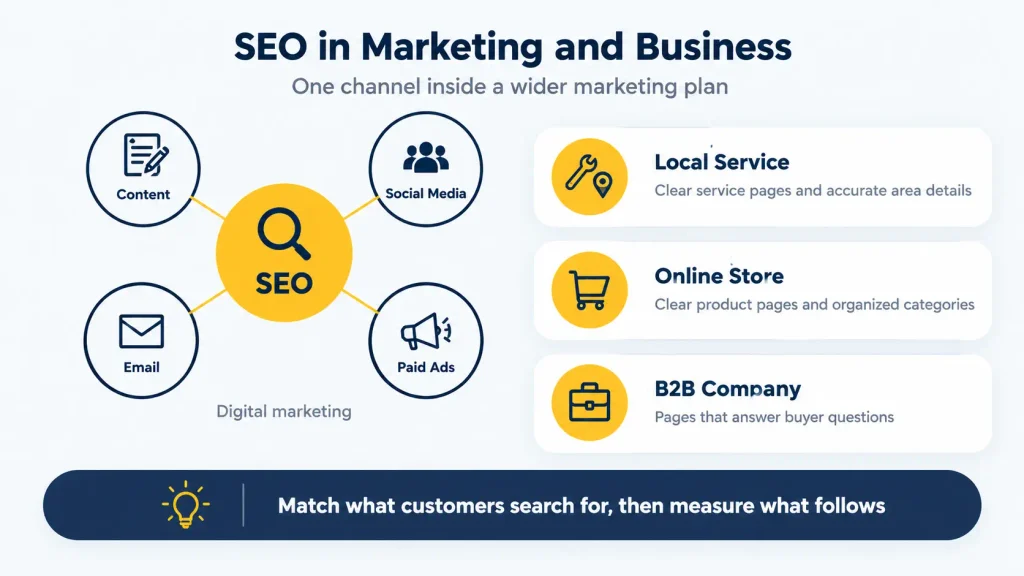
In marketing, SEO is one channel inside digital marketing. It is sometimes called organic search marketing or SEO marketing. The two terms are related but not the same, because digital marketing also includes social media, email, paid ads and more. SEO marketing typically involves keyword research, understanding search intent, creating website content, keeping the site technically healthy and measuring results. It often works alongside content marketing.
In Business
For a business owner, SEO means making products and services easier to find online. A local plumber needs clear service pages and accurate area details. An ecommerce store needs clear product pages and organized categories. A B2B company needs pages that explain solutions and answer buyer questions. In each case, the aim is to answer what customers ask and to measure the visits and inquiries that follow. There is no standard return on investment, and nobody can promise one.
What Does SEO Mean for a Website?
On a website, SEO covers single pages and the site as a whole. It is much more than adding keywords. Common elements include:
- Page titles and meta descriptions. Short text that describes each page in search results.
- Headings and content. Clear sections that answer the topic.
- Internal links. Links between your pages that help visitors and crawlers move around.
- Images. Clear file names and alt text that describe what an image shows.
- Site structure. A layout that makes pages easy to find.
- Mobile use and speed. Pages that work on phones and load without long waits.
- Crawlability and indexing. Pages that search engines can reach and store.
- Structured data. Extra markup that describes content, where it fits. Our guide to a schema validator explains how to check it.
- Links from other sites. References from relevant, reputable sources.
What Are the Main Types of SEO?
On Page SEO
On page SEO covers what is on each page: titles, headings, content relevance, internal links and image information. See our on page SEO service.
Technical SEO
Technical SEO makes sure search engines can reach and understand your site. It covers crawling, indexing, site structure, speed and rendering. See our technical SEO service.
Off Page SEO
Off page SEO covers things outside your site, such as relevant links from other sites, mentions and reputation. Avoid buying links or using link schemes, because they can break search engine rules. Learn more about off page SEO.
Local SEO
Local SEO helps nearby customers find a business. It includes an accurate Google Business Profile, consistent details, local pages and reviews. See our local SEO service.
Content SEO
Content SEO means creating pages that answer search intent and cover a topic well. Our guide to SEO content explains how to plan and write it, and good content writing is the base of it.
Other specialties exist, such as ecommerce SEO and international SEO. They build on the same ideas.
What Is an SEO Example?
A local plumber. The plumber creates a clear page for each service, lists the areas they cover, answers common questions such as what to do in an emergency, and keeps their business profile accurate. The purpose is to help nearby people find real, useful information.
An online store. The store writes clear product descriptions, groups products into logical categories, gives each page a unique title and makes sure pages load quickly on phones. The purpose is to help shoppers find the right product and help search engines understand the catalog.
These examples show the process and goal, not guaranteed results.
What Is the Difference Between SEO and PPC?
PPC means pay per click. It is a form of paid advertising in which an advertiser typically pays when someone clicks an ad. SEO focuses on organic results, where you do not pay for each click.
| SEO | PPC | |
|---|---|---|
| Main approach | Improve your site for organic visibility | Run paid ads |
| How traffic is gained | From unpaid search listings | From ads shown in search or elsewhere |
| Payment model | No per click fee, but costs for time, content, tools and technical work | Typically pay per click or per impression |
| Time and effort | Builds gradually and needs upkeep | Can start quickly, stops when spending stops |
| Measurement | Rankings, organic traffic, conversions | Clicks, cost, conversions |
| Best for | Long term visibility and information | Promotions and fast visibility |
| Limits | No guaranteed rankings or timelines | No guaranteed sales, and costs can rise |
Many businesses use both channels together. Neither guarantees sales.
How Is SEO Different From AI Search, AEO and GEO?
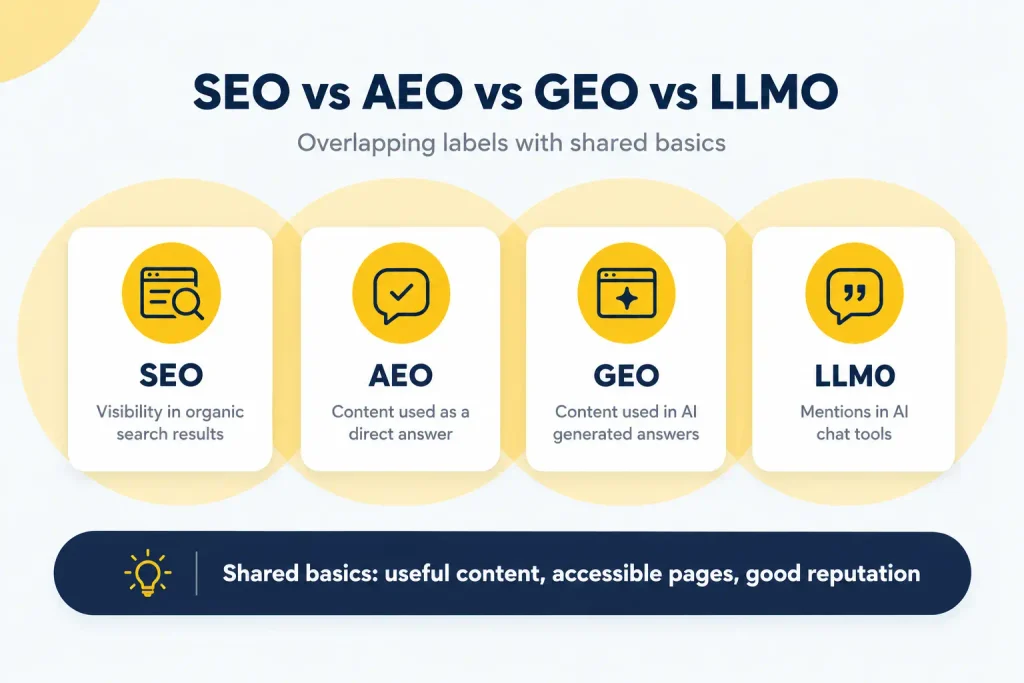
AI tools now answer questions directly, and new labels have appeared around them. These labels are used differently across the industry, and none is a formally defined, separate discipline. The table below is a descriptive guide, not an official standard.
| Label | Commonly used to describe |
|---|---|
| SEO | Improving visibility in organic search results |
| AEO (answer engine optimization) | Preparing content so it can be used as a direct answer |
| GEO (generative engine optimization) | Preparing content for AI generated responses |
| LLMO (large language model optimization) | Getting mentioned or cited by AI chat tools |
These labels overlap and share most of the same basics: useful content, accessible pages and a good reputation. Google says that for its Search, working on generative AI features is still SEO. No technique can guarantee inclusion in an AI answer. For more detail, read our guides to answer engine optimization and generative engine optimization.
How SEO Keeps Changing
SEO follows how people find information, so it changes as technology and habits change.
Mobile Use and Speed
Google uses the mobile version of a site’s content, crawled with its smartphone crawler, for indexing and ranking. This is called mobile first indexing. Google says a mobile version is not required for your content to appear in Search, but it strongly recommends one. If content appears only on desktop, Google may miss it. Fast pages that work well on phones also help visitors.
Social and AI Search
People do not only search on Google. They also look for answers on other search engines, on video platforms and social apps, and in AI chat tools. That does not mean an SEO specialist handles every platform. It does mean marketing teams should share what they learn about audience questions.
Changing Behavior
How people research before buying, judge trust and expect privacy also shifts. Good SEO strategy considers both technology and human behavior.
SEO Jobs and Careers
SEO is both a marketing practice and a job title. In a job context, “SEO” can mean the work or the person doing it.
An SEO professional works to improve how a website performs in search. Common tasks include researching keywords and search intent, planning content, reviewing page titles and text, running technical checks, researching competitors, improving internal links, reporting on search performance and working with writers, developers and marketers. Titles include SEO specialist, SEO analyst, SEO manager and SEO consultant. Responsibilities differ a lot between employers.
What about pay? There is no single SEO salary. In the U.S. Bureau of Labor Statistics data I checked, SEO specialist is not a separate occupation. A related category is market research analysts, and BLS reported a median annual wage of $76,950 for that occupation in May 2024, as a national U.S. figure in its Occupational Outlook Handbook. That figure is not SEO specific. SEO pay varies with experience, location, employer, responsibilities and specialization, so check current job listings for the roles you care about.
SEO Skills and How Beginners Can Learn SEO
The basics are easy to learn, but doing SEO well takes practice. There is no single required qualification, so most people build skill through study and real projects. How hard a job is depends on the role, technical demands, experience required and the workplace.
Essential Skills for SEO Work
- Keyword research and understanding search intent.
- Writing and reviewing web content.
- Basic technical SEO.
- Reading search performance data.
- Understanding site structure and internal links.
- Using SEO tools.
- Clear communication and problem solving.
How to Start Learning SEO
- Learn how search engines work, starting with Google’s guide.
- Learn keyword research and search intent.
- Study on page SEO.
- Learn basic technical SEO.
- Practice writing or reviewing web content.
- Review results and improve based on evidence.
No course or tool can promise a job or a fixed learning time.
Practicing SEO on a Website
Skill grows through practice. Start a small site or help a local business with its pages. Review your own pages against what you learn. Keep notes on what you change and what happens, so you learn from evidence.
Tools and Resources for Beginners
Google Search Console and Google Analytics are free and show how a site performs. Google Search Central documentation and the SEO Starter Guide are good official starting points. Follow official guidance, because search engines update their systems and documentation.
Common SEO Misunderstandings
- “SEO means adding keywords.” Keywords help, but SEO also covers content quality, structure and technical health.
- “SEO guarantees first page rankings.” It does not. Nobody can promise a ranking.
- “More keywords means better rankings.” Repeating a phrase does not help and can hurt readability.
- “SEO and PPC are the same.” One is organic, the other is paid.
- “Every page gets indexed.” Google says not every page is indexed.
- “SEO works overnight.” It usually takes time and depends on competition.
- “One checklist fits every site.” Every site has different needs.
- “AI search replaces SEO.” Google says SEO fundamentals still apply to its AI features.
How SoftAge Solutions Can Help With SEO
SoftAge Solutions is an IT company that offers SEO and digital services. Its SEO work covers technical SEO, on page SEO, off page SEO and local SEO, along with content writing and web development. Together, these can support your website and search visibility goals.
We do not promise rankings, traffic or leads, because those depend on your market, your competition and your site.
FAQs
What is SEO and how does it work?
SEO means search engine optimization. It is the work of helping search engines find, understand and show your pages. Search engines crawl pages, index eligible ones and serve results that seem relevant.
What does SEO stand for?
It stands for search engine optimization.
How do I start SEO for beginners?
Learn how search engines work, study keyword research and on page SEO, practice on a real website and use Google Search Console to check results.
What is an SEO example?
A local plumber creating clear service pages, listing service areas and keeping business details accurate so nearby customers can find them.
What is SEO skill?
It is the mix of keyword research, content writing, technical basics, data reading and communication used to improve search visibility.
Is SEO job easy?
It depends on the role. The basics are easy to learn, but real work takes practice, and technical roles can be demanding.
What is SEO salary?
There is no single figure. The closest federal category is market research analysts, which BLS reported at a median of $76,950 per year in May 2024. That is not an SEO specific number, and SEO pay varies with experience, location, employer and role.
What is the difference between SEO and PPC?
SEO focuses on unpaid organic results. PPC is paid advertising, where you typically pay when someone clicks an ad.
How is SEO different from GEO?
SEO focuses on visibility in search results. GEO focuses on being used in AI generated answers. They share most of the same basics.
How long does SEO take to work?
There is no fixed timeline. It depends on competition, content quality, the site’s condition and how often search engines revisit it.
Is SEO still useful?
Yes. People still search, and Google says SEO fundamentals apply to its AI features too.
Conclusion
SEO means search engine optimization: making your website easier to find, understand and use, so the right people can discover it through search. It works through crawling, indexing and serving, and it covers content, technical health, local details and reputation.
Keep your expectations realistic. SEO builds gradually, depends on many factors and cannot be guaranteed. Focus on useful content, an accessible site and honest measurement.
Want help improving your website’s search visibility? Contact SoftAge Solutions to discuss your goals and a suitable SEO approach.