Understanding Ontology and Taxonomy in SEO
Ever heard words like ontology and taxonomy thrown around in SEO discussions and thought, “That sounds complicated”?
You’re not alone. They sound technical, but they’re actually simple ideas that help your content make sense to both people and search engines.
When you get these two rights, your content stops being just a pile of pages, it becomes a connected, structured ecosystem that Google loves.
What Is Ontology in SEO?
Let’s start with ontology.
In SEO, ontology means how topics, ideas, and entities are related in meaning.
It’s like building a web of understanding that connects everything on your site logically.
Think of ontology as your site’s “meaning map.”
Here’s a quick example for a Contract Management website:
- Entities: Contract, Client, Vendor
- Relationships: Client ↔ Contract, Contract → Clause
Ontology helps Google see the real-world logic behind your content:
A client signs a contract that includes clauses, and a vendor provides services.
So instead of just reading words, search engines understand the context and intent behind them.
That’s why ontology is a core part of semantic SEO, it focuses on meaning, not just keywords.
What Is Taxonomy in SEO?
Now, let’s talk about taxonomy.
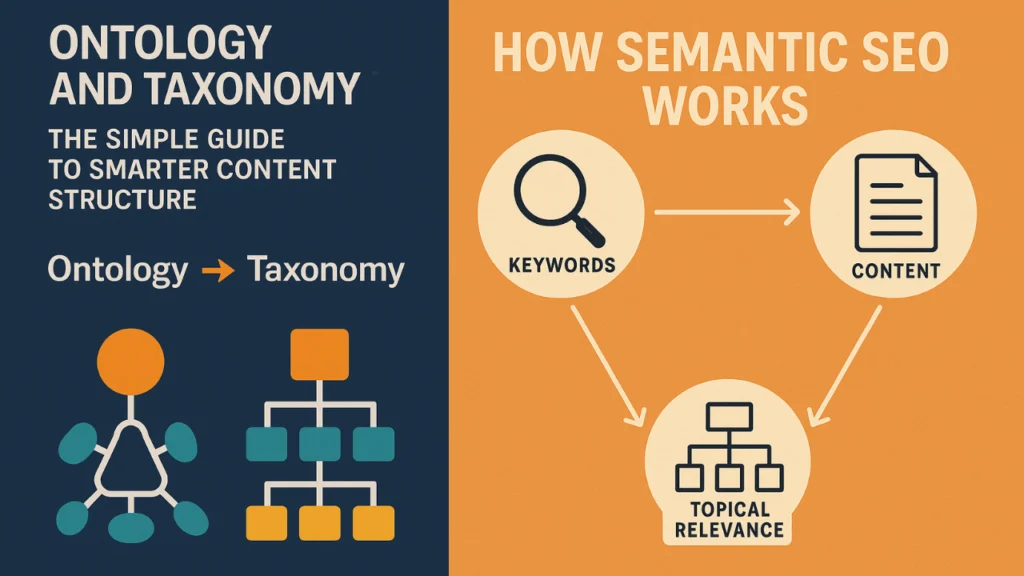
While ontology focuses on meaning, taxonomy focuses on organization — how you structure your website content.
Think of taxonomy like a folder system on your computer.
It keeps everything neat, logical, and easy to find.
Example:
Contract Management
Templates
NDA Template
Employment Contract Template
That’s taxonomy in action.
It tells Google and your users how your content is grouped, categorized, and connected.
It makes your site easier to crawl and helps your visitors navigate without confusion.
Ontology vs. Taxonomy: The Real Difference
The easiest way to remember it is
| Ontology | Defines the meaning and relationships between things | Client ↔ Contract ↔ Clause |
| Taxonomy | Defines the structure or organization of those things | Contract Management → Templates → NDA Template |
Both are essential for semantic SEO success.
When ontology gives your content context, and taxonomy gives it structure, your site becomes easier to understand, navigate, and rank.
Why They Matter for SEO
Google’s algorithms today don’t just match keywords, they understand concepts.
That means your website’s performance depends on how clearly it communicates meaning and connections.
Here’s how ontology and taxonomy help:
- They improve search visibility by showing Google the relationships between your pages.
- They enhance user experience, making your site logical and easy to explore.
- They build topical authority, helping Google see your site as an expert source in your niche.
In short, when your site is organized by taxonomy and connected by ontology, it becomes both smart and searchable.
How to Apply Ontology and Taxonomy to Your Website
You don’t need complex software or a philosophy degree to use these ideas.
Here’s a simple approach:
- Start with topics, not keywords.
Think about what your audience wants to learn, not just what words they type. - Map relationships.
Identify how your topics connect. Example: Contract → Clause → Legal Terms. - Organize content.
Group related articles into categories and subcategories that make sense. - Use internal linking.
Link related topics together to help both users and search engines understand the flow. - Keep it natural.
Don’t overthink the terminology. You’re just organizing meaning in a smart way.
Bottom Line
Next time someone mentions “ontology modeling” or “taxonomy mapping,” don’t panic.
They’re not complicated concepts, they’re just the meaning and organization behind your website.
- Ontology connects your ideas.
- Taxonomy structures your content.
Ontology and Taxonomy make your site more intelligent, discoverable, and SEO-friendly.
That’s semantic SEO made simple.
Language Behind Search
Have you ever wondered why some articles show up everywhere while others disappear, even when they use the same keywords?
It’s not luck. It’s not magic. Its meaning.
Search engines no longer look at what you say, they look at what you mean.
And that’s where the real story of modern SEO begins.
Let’s take a slow walk through it, step by step, like we’re figuring out how the internet thinks.
Search Isn’t About Words Anymore
There was a time when ranking meant repeating your keyword ten times and hoping for the best.
But the internet has changed.
Search engines have learned to listen like humans do.
They can tell if you’re answering a question, explaining an idea, or just filling space.
When someone searches “how to start a garden”, Google doesn’t just look for those exact words anymore.
It also looks for phrases like “planting tips,” “soil preparation,” “tools for beginners,” or “best plants for shade.”
It reads between the lines.
It listens to context.
It tries to understand your intent.
That’s what makes the difference between a post that appears once and a post that stays visible for years.
What Meaning Looks Like in SEO
Meaning lives in the way ideas connect.
Let’s take a simple example.
Imagine a website about contract management.
There are three important ideas: Contract, Client, and Vendor.
These ideas connect to each other naturally:
- A client signs a contract.
- A contract includes clauses.
- A vendor delivers what’s written in the contract.
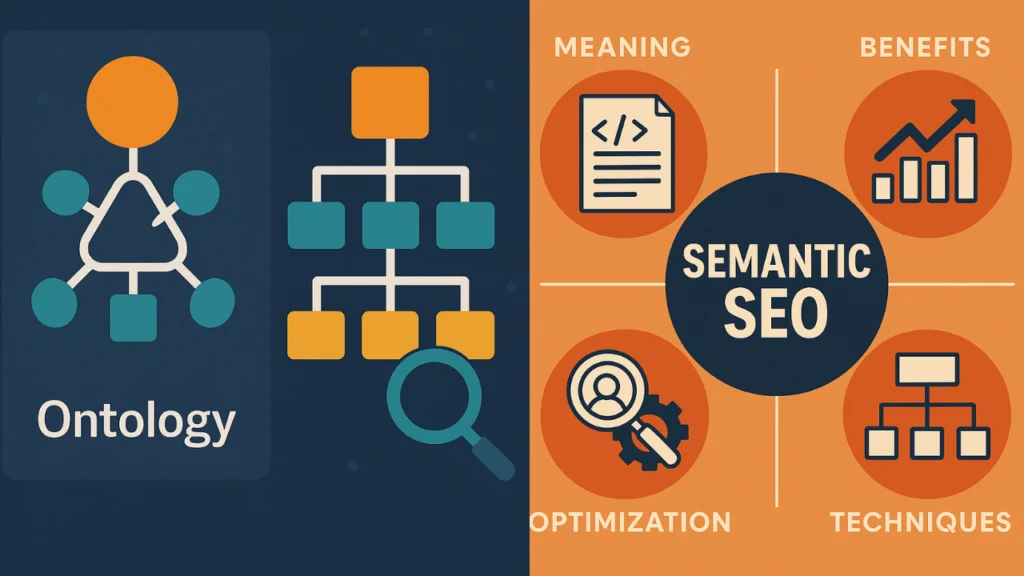
These relationships form what we call ontology, the web of meaning between concepts.
It’s not a technical term once you see it this way.
Ontology is just the way your ideas talk to each other.
If your site clearly reflects those connections, Google can see the full story, not just fragments.
And when your story makes sense, your site becomes a trusted source on that topic.
The Power of Structure: Why Organization Matters
Now, meaning needs structure to stay clear.
That’s where taxonomy comes in.
Think of taxonomy like a bookshelf.
It’s how you arrange ideas so readers — and search engines — can follow your logic.
For example:
Contract Management
→ Templates
→ → NDA Template
→ → Employment Contract Template
You’re not just stacking words.
You’re showing how each idea fits into a bigger idea.
This order helps Google understand your world step by step, like reading chapters of a book.
It also helps people feel safe on your site. They know where they are and what comes next.
Good taxonomy is quiet but powerful.
It doesn’t just improve navigation, it strengthens meaning.
How Search Engines Read Meaning
When you write an article, Google doesn’t only check if you used the right keywords.
It checks if your words make sense together.
If your site covers “running shoes,” Google expects to see related topics such as “arch support,” “running technique,” and “footwear brands.”
It compares how your ideas connect to how other trusted sites connect theirs.
This process helps search engines decide who truly understands the topic.
That’s why it’s no longer enough to have one “perfect keyword.”
You need a network of connected ideas.
The internet rewards those who build knowledge, not those who copy words.
From Words to Context: The Human Shift
Let’s make this simpler.
When you talk to a friend, you don’t repeat one word over and over to make a point.
You use related examples, feelings, and stories.
That’s exactly what search engines expect now.
They look for context that makes the content sound like a real person helping another real person.
If your blog about gardening includes advice about sunlight, watering, and soil care, it doesn’t just look useful.
It is useful.
Meaning shows in how you care about the reader, not how many times you repeat “garden tips.”
That’s the quiet truth of today’s SEO empathy ranks higher than repetition.
Building Trust Through Meaning
Trust is what the internet craves the most.
Search engines and people both need it before they listen to you.
When you create content that connects ideas clearly and deeply, you build that trust.
For example, if a reader finds one helpful post on your site and sees another linked post that expands on that idea, they stay longer.
This tells Google, “People find this site valuable.”
But it also tells your readers, “Someone here understands what I need.”
That’s how you build topical authority not by chasing trends, but by patiently building meaning over time.
A Simple Story of Two Websites
Let’s say two websites talk about healthy eating.
The first one writes a short post called “Healthy Diet Tips” and moves on.
The second one writes a full series:
- What a balanced diet means
- How nutrition affects sleep
- Why certain foods boost energy
- Recipes that make it easy to stay consistent
The second site becomes a small ecosystem of understanding.
Search engines notice the connections.
Readers start bookmarking it.
Soon, that second website doesn’t just rank for “healthy diet.”
It ranks for everything around it, sleep, recipes, vitamins, and wellness.
That’s the reward of building meaning, not noise.
Ontology and Taxonomy
Think of ontology as the heart and taxonomy as the skeleton.
One gives life, the other gives shape.
Ontology tells Google what connects to what.
Taxonomy shows how it’s all organized.
When these two work together, your content doesn’t just exist, it communicates.
It explains itself naturally without needing forced keywords or complex hacks.
It says, “Here’s what I mean, and here’s how all of it fits together.”
And Google loves that kind of clarity because people do, too.
How Meaning Builds Topical Authority
Let’s step back and imagine your site as a growing tree.
- The roots are your ontology connections that hold everything together.
- The branches are your taxonomy, the structure that shapes growth.
- The leaves are your articles, the visible expression of your ideas.
If your roots are shallow, your tree falls in a storm.
If your branches are messy poor structure, your leaves can’t breathe.
But when both roots and branches work together, your site stands strong and grows naturally.
That’s how topical authority feels steady, balanced, and alive.
Google sees it. Readers feel it.
And that emotional connection is what keeps your site relevant.
Real Example: The Local Bakery
Imagine a bakery owner named Sana who runs a small website.
She used to post random blogs like “Best Cakes in Town” or “Buy Cupcakes Today.”
They didn’t perform well.
One day, she decided to rebuild her content with meaning.
She created a small map of her topics.
- Baking basics
- Ingredients and flavors
- Celebration cake ideas
- Tips for home bakers
Then she linked them naturally:
Articles about ingredients connected to recipes.
Recipes connected to occasions.
Occasions connected back to her products.
Within months, her blog became a trusted local guide for baking.
Her pages started ranking for hundreds of related searches, not because of tricks, but because her website finally made sense.
That’s the quiet success of ontology and taxonomy working together.
Guest Posting: Extending Your Meaning
Guest posting is another way to expand your world of meaning.
It’s not just about backlinks; it’s about building bridges of context.
When you write for another site that shares your topic, you show Google that your ideas belong to a wider conversation.
You connect two webs of meaning.
If your article on a marketing blog links naturally to your own detailed piece on brand storytelling, that’s not manipulation, that’s collaboration.
It’s how the web was meant to work: knowledge linking to knowledge. Guest posting done right is like cross-pollination in nature.
It spreads ideas, strengthens context, and helps your authority grow across different ecosystems.
Why Meaning Will Outlast Every Algorithm
Algorithms come and go, but understanding stays.
When you focus on meaning, your content won’t crumble after the next update.
You’ll always align with how humans think, and that’s what every algorithm tries to imitate.
Think about your favorite writers.
You don’t love them because they used the right keywords.
You love them because their words made sense to you.
That’s the kind of writing search engines now value too.
It’s the internet’s quiet return to authenticity.
A Human Lesson for Writers and Marketers
The best SEO advice isn’t about tools or tricks.
It’s about listening.
Listen to what your audience means, not what they say.
Write to solve, not to sell.
Structure your thoughts like a map someone can follow.
When people feel understood, they trust you.
And when search engines see that trust, they follow it.
Meaning builds relationships, not just rankings.
Bringing It All Together
Let’s simplify everything:
- Ontology is how your ideas connect.
- Taxonomy is how they’re organized.
- Meaning is what gives them life.
- Trust is what keeps them alive.
This is the foundation of modern search, not algorithms, but understanding.
When your content carries meaning, your website stops being a collection of pages.
It becomes a network of ideas that helps people and teaches machines.
And when you reach that point, you’re no longer chasing SEO.
You’re leading it.
A Quiet Reminder
Behind every search is a person looking for clarity.
Behind every article is a writer trying to be heard.
Semantic SEO, or simply meaningful writing, bridges that gap.
It reminds us that connection comes before clicks, and understanding lasts longer than trends.
So write with care.
Organize your ideas with purpose.
And trust that meaning will always find its way to the surface.