

Type a question into Google, ChatGPT or Perplexity and you often get a short written answer before you see a single link. Answer Engine Optimization (AEO) is the work of getting your content ready for that moment. It means making your pages clear, accurate and easy to find, so a search tool has good material to use when it answers a question about your topic.
This guide keeps things simple. You will learn what AEO means, how answer engines work, how AEO compares with SEO and GEO, what to do on your own pages, and how to measure it. You will also see what nobody can promise you.
Key Takeaways
- Answer engines respond to a question with a written answer, often with links to the sources.
- AEO builds on SEO. Google says specific optimization is not required for its AI features, and normal SEO basics still apply.
- The core work is simple: answer questions clearly, keep facts accurate, organize pages well and make sure systems can reach them.
- No tactic can guarantee a citation, a brand mention or more traffic.
- Measurement is partial. Google’s Search Console now reports impressions in its AI features, and other platforms report differently.
- People use the terms AEO and GEO in different ways, so check what a writer means before you follow their advice.
What Is Answer Engine Optimization (AEO)?
Answer Engine Optimization is the practice of preparing your content so search tools and AI assistants can find it, understand it and use it when they give someone a direct answer.
You will hear the term used in a few ways. Some people mean winning featured snippets and voice answers. Others mean being cited in AI written answers. Many treat it as another name for generative engine optimization (GEO). Nobody has set one official definition, and that is fine. The practical work is much the same.
What Are Answer Engines?
An answer engine responds to a question with a written answer instead of only a list of links. Some live inside search engines, like Google’s AI Overviews. Others are assistants with search built in, like ChatGPT search.
Why Businesses Are Paying Attention
People now ask longer, more specific questions, and they often see a summary at the top of the page. If your customers ask about what you sell, you want your pages to be clear and correct when a system goes looking for answers. That is good practice with or without a new label.
How Does Answer Engine Optimization Work?
Every platform works a little differently, and none of them publishes every detail. Still, the basic flow looks like this:
- Someone asks a question.
- The system looks for pages that might help. This depends on your pages being crawled and indexed.
- It picks passages or sources that seem useful and reliable.
- It writes an answer and may show links or citations.
Your part is in step two and step three. You cannot control which source gets chosen, but you can make your pages easy to find and worth choosing.
How Google Handles It
Google’s documentation says AI Overviews and AI Mode may use a technique called query fan out. That means they run several related searches across different subtopics to build a response. Google also says the two features may use different models and techniques, so what they show can vary.
To be eligible, a page must be indexed and able to appear in Search with a snippet. Google says no special optimization is required and that existing SEO fundamentals still matter. It also says you do not need special Schema.org markup for these features. You can read the details in Google’s guide, AI features and your website.
How ChatGPT Search Handles It
OpenAI documents separate crawlers for separate jobs. OAI-SearchBot is used to surface sites in ChatGPT search. According to OpenAI, sites that opt out of it will not be shown in ChatGPT search answers, though they may still appear as plain navigational links. GPTBot is a separate setting connected to training. OpenAI says robots.txt changes can take about 24 hours to take effect for search.
What About Other Platforms?
Microsoft Copilot, Perplexity and voice assistants each have their own methods. I did not check their publisher guidance for this article, so read each platform’s official documentation before you act on advice about it.
Types of Answer Engines
| Type | Examples | What to know |
|---|---|---|
| Answer features in search | Featured snippets, People Also Ask, knowledge panels | Older formats that show a direct answer on the results page |
| AI features in search | Google AI Overviews, AI Mode | Generated summaries with links, inside Google Search |
| AI assistants with search | ChatGPT search, Microsoft Copilot, Perplexity | Conversational tools that can search and cite sources |
| Voice assistants | Siri, Alexa | Spoken answers, often drawn from other sources |
Answer Engine Optimization vs SEO vs GEO
These three terms overlap, and writers use them differently. The table below shows one common way to compare them. It is not an official standard.
| SEO | AEO | GEO | |
|---|---|---|---|
| Main focus | Visibility in search results | Being used as a direct answer | Being used in generated responses |
| What users see | A ranked list of links | Snippets and AI answers | AI written answers |
| Content | Pages built around intent and keywords | Clear answers to specific questions | Clear, well sourced passages that are easy to quote |
| Technical work | Crawling, indexing, speed | The same base, plus crawler access | The same base, plus crawler access |
| Measurement | Rankings, clicks, traffic | Impressions, mentions, referrals where available | Citations and mentions, often checked by sampling |
| Limits | Results vary with competition | Selection is never guaranteed | Selection is never guaranteed |
Here is the simple takeaway. AEO does not replace SEO. Answer engines still depend on content that can be found, crawled and trusted. Our guide to technical SEO covers that foundation.
Why Answer Engine Optimization Is Worth Your Attention
Good AEO work can help you:
- Write content that answers real customer questions.
- Make your pages clearer and more accurate for every reader.
- Find topics your site has not covered yet.
- Get ready for search experiences that show direct answers.
Results depend on your competition, the platform, your website and how people search. None of these benefits is guaranteed.
How to Prepare Content for Answer Engines
Start With Real Customer Questions
Begin with what people actually ask. Look at sales calls, support emails and the queries in Search Console. Group them by topic and by what the person wants to do next.
Give a Clear Answer Early
Answer the question in the first lines, then add context. Here is a quick example.
Before: “Canonical tags are a topic many site owners find confusing, and there are several things to think about.”
After: “A canonical tag tells search engines which version of a page you prefer when similar pages exist. Use it when the same content can be reached at more than one address.”
The second version is easier for readers, and it gives any system a clear passage to quote. No platform has said that one answer length is preferred, so write as long as the answer needs.
Use Headings That Say Something
Write headings that tell readers what a section covers. Some can be the questions your customers ask. Keep one idea per section so each passage still makes sense when read alone.
Cover the Topic Without Repeating Yourself
Answer the main question and the related ones around it. Good on page SEO work already does this through titles, headings, internal links and useful content.
Back Up What You Say
Link to official documentation and credible references. Name the source for any fact, and skip statistics you cannot support. Strong content writing means every claim can be traced.
Keep Information Current
Review pages when your services, prices, policies or platform guidance change. An out of date answer misleads readers, whatever tool shows it.
Make Your Pages Easy to Reach
Check that pages can be crawled, indexed and displayed properly, and that they work well on a phone. Review your robots.txt file and any security or firewall rules. If you want ChatGPT search to consider your site, OpenAI recommends allowing OAI-SearchBot and its published IP ranges. Internal links also help systems find your pages.
Use Structured Data Carefully
Structured data, often written in JSON-LD, describes what a page is about. It can help systems read a page, but Google says its AI features need no special markup. Keep any markup accurate, make sure it matches what visitors see, and validate it. Our guide to schema validators will help here.
Show Real Experience
Tell readers who wrote the content and why they know the topic. Use real examples from your own work and real business details. Never invent credentials, clients or case studies. Mentions on other sites also build trust, which is part of off page SEO, though nobody can promise a mention.
A Quick Checklist Before You Publish
- Does the page answer a real question in its first lines?
- Are the headings clear and specific?
- Are the facts accurate, sourced and current?
- Can search tools reach the page, with nothing blocking it?
- Does any structured data match the page and pass validation?
AEO Examples by Business Type
The right questions depend on who your customers are.
- Local businesses. People ask about hours, services, prices and service areas. Keep your business details consistent everywhere. Our local SEO service covers related work.
- Professional services. Clients ask how a process works and what to expect. Explain each step in plain words.
- Ecommerce stores. Shoppers ask about sizes, shipping and returns. Product pages and policy pages should answer these directly.
- B2B companies. Buyers compare options and ask whether a product fits. Clear comparison and fit pages help.
- SaaS companies. Users ask how features work and how tools connect. Help pages and documentation matter most.
- Publishers. Readers ask factual and how to questions. Accurate, well sourced articles are the base.
How to Measure Answer Engine Optimization
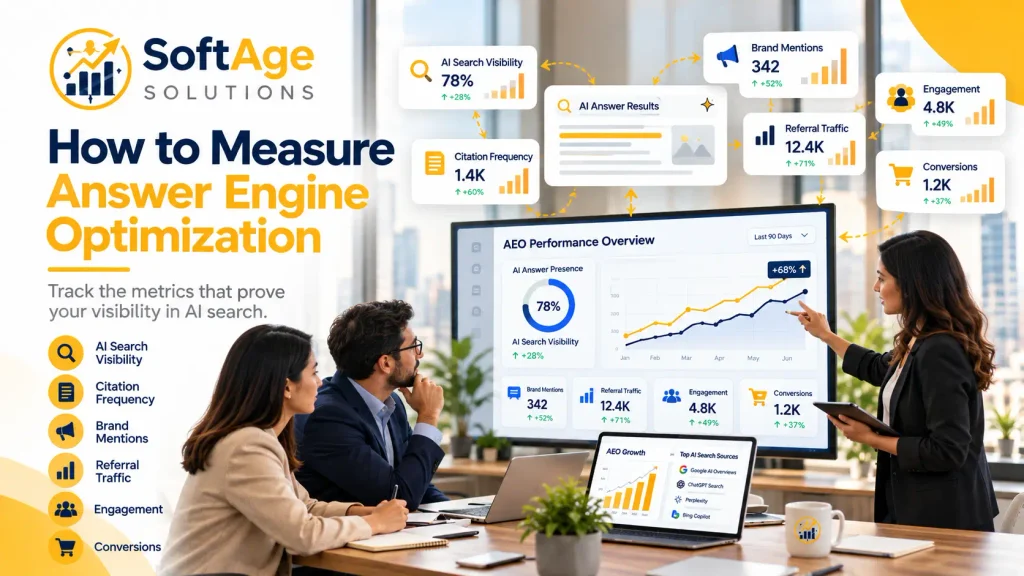
Measurement is partial, so use more than one signal.
- Search Console. Google says traffic from AI features like AI Overviews and AI Mode is included in the overall Search Console performance data. In June 2026, Google also announced dedicated Search Generative AI performance reports that show impressions in these features, with details such as pages and devices. The data also stays in the main report. Availability may vary by property, so check your own account. You can read the details in Google’s announcement.
- Referral traffic. Check your analytics for visits from AI platforms, where the source is identified.
- Mentions and citations. You can check manually for the questions that matter most to you. Third party tools that estimate AI visibility rely on sampling, so treat their numbers as estimates.
- Branded search and leads. Watch branded searches, qualified leads and conversions.
- Technical health. Keep an eye on indexing and crawl problems.
Record a baseline before you change anything, and expect attribution to be incomplete.
Common Answer Engine Optimization Mistakes
- Treating AEO as a replacement for SEO. It builds on SEO.
- Publishing generic content. Add detail only your business can give.
- Repeating keywords unnaturally. Write for people first.
- Adding structured data that does not match the page. Markup has to reflect what visitors see.
- Making claims you cannot support. Name your sources.
- Treating every platform the same. They work differently.
- Expecting quick results. No timeline is guaranteed.
- Trusting visibility scores you cannot verify. Learn how a tool collects its data.
- Using automated content without checking it. Review every fact.
- Ignoring technical SEO and updates. Pages need ongoing care.
A Simple Answer Engine Optimization Plan
Treat this as a starting point, not a formula.
- Write down your business goals and the questions your audience asks.
- Review your current organic search and website performance.
- Find out which answer experiences your audience uses.
- Audit content quality and technical access.
- Pick the pages that need work first.
- Check structured data where it applies.
- Publish improvements and keep them current.
- Track the signals you can see and review the results.
How SoftAge Solutions Can Help
SoftAge Solutions is an IT company that offers SEO and digital services. Its work covers technical SEO, including structured data, crawlability and indexing, as well as on page SEO, off page SEO, local SEO and content writing. It also offers web development, which matters when site structure and templates affect how content is read.
These services can support a wider search visibility plan. We do not promise AI citations, mentions, traffic or leads, because many factors outside any one team’s control decide them.
FAQs
What is Answer Engine Optimization?
It is the practice of preparing content so search tools and AI assistants can find it, understand it and use it in direct answers. Definitions vary across the industry.
What is the difference between AEO and SEO?
SEO focuses on visibility in search results. AEO focuses on being used in direct answers. They share most of the same foundations.
Is AEO replacing SEO?
No. Answer engines still rely on content that can be crawled, indexed and trusted. Google says SEO fundamentals remain worthwhile for its AI features.
What is the difference between AEO and GEO?
They overlap heavily and are sometimes used for the same thing. GEO usually refers to generated responses, and AEO is used more broadly for answer formats.
How can I improve content for answer engines?
Answer questions clearly, use specific headings, keep facts accurate and sourced, keep pages reachable and update them regularly.
Does schema markup help with AEO?
It can help describe a page, but Google says no special Schema.org markup is needed for its AI features. Markup does not guarantee a citation.
How do you measure AEO performance?
Use Search Console, referral traffic from AI platforms where you can identify it, manual checks of mentions and your leads. Measurement is partial and differs by platform.
How long does AEO take?
No one can say. Results depend on competition, content quality, the platform and how people search.
Is AEO useful for small businesses?
Often yes, because it pushes you to answer customer questions clearly. Results are not guaranteed.
Can AEO help a business attract leads?
It can support visibility and help people find clear information, but it does not guarantee leads. Track conversions to see what works.
Conclusion
Answer Engine Optimization is mostly careful, honest content work: clear answers, accurate facts, good structure and pages that systems can reach. It builds on SEO, it sits alongside GEO, and its definitions are still settling.
Focus on what you can control and measure what you can see. Be wary of anyone who promises guaranteed AI visibility.
Want help reviewing your website content and search visibility? Contact SoftAge Solutions to discuss your goals and a suitable approach.