
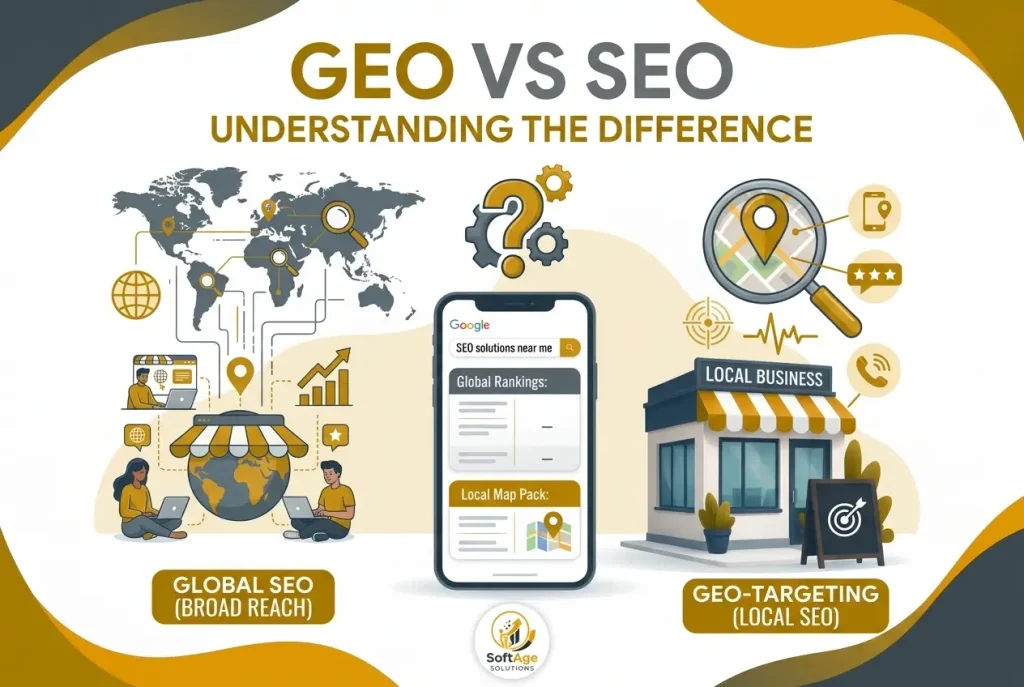
Ask an AI tool a question, and you often get a written answer with a few source links beside it. Search on Google, and you may see an AI summary above the usual results. People now find information in more than one way, and that has created a new term: GEO.
GEO stands for Generative Engine Optimization. This guide explains how GEO and SEO differ, where they overlap, and how a business can approach both without hype.
Key Takeaways
- SEO is the work of helping search engines find, understand, and rank your pages so people can reach your website.
- GEO means Generative Engine Optimization. It is work aimed at making information easier for generative AI systems to understand, retrieve, summarize, mention, or cite when it fits.
- The main difference is where visibility happens. SEO focuses on a list of results with links. GEO focuses on written answers produced by AI.
- Traditional search and generative search can differ in format, in the sources shown, and in how often people click. AI platforms also differ from each other.
- SEO still matters. Google says the usual SEO fundamentals apply to its AI features, and a page must be indexed and eligible to show with a snippet to appear as a supporting link.
- GEO is not a guaranteed replacement for SEO, and no tactic guarantees AI citations or mentions.
- Many businesses may want both. The right mix depends on goals, audience, industry, and resources.
GEO vs SEO| What’s the Difference?
SEO is the practice of improving a website so it can appear in search engine results and earn visits from people who search. GEO is the practice of making information easier for generative AI systems to understand, retrieve, summarize, mention, or cite when it is relevant.
Here are the main terms in plain English:
- Search Engine Optimization (SEO). Work that helps a website appear in search results.
- Generative Engine Optimization (GEO). Work that helps your information be understood and used in AI-generated answers.
- Traditional search. You type a query and the search engine returns a ranked list of links, sometimes with extra features.
- Generative search. The system writes a natural language answer, often built from several sources.
- AI powered search. A broad label for search experiences that use AI. This includes AI summaries on a results page, chat style search, and assistants that browse the web.
SEO usually focuses on the page and where it appears. GEO focuses on the information on the page and how an AI system might use it in an answer.
Two cautions apply. First, AI search systems do not all work the same way. Second, no checklist can promise that you will appear in an AI answer.
You may also see the term AEO, which means answer engine optimization. People use AEO and GEO in similar ways. Google takes a clear position on this. In its guide for site owners, it says that working to improve visibility in generative AI search is work on the search experience, and so it is still SEO. Search Engine Journal’s summary of the guide is a good short read if you want the key points. That is a useful way to think about the topic. GEO is a handy label, but it does not replace SEO.
Understanding SEO| Search Engine Optimization
SEO helps people find your website through organic search. Organic results are the unpaid listings that a search engine shows because it judges them relevant and useful. Paid search ads are different. An advertiser pays for those placements, usually per click. Organic visibility does not carry a per click fee, but it takes time and steady work.
Businesses use SEO for a simple reason. People search for answers, products, and services. If your pages match what they need, you have a chance to reach them.
Search results depend on several things working together: relevance to the query, content quality, links from other sites, technical health, and user experience. No single formula decides the order.
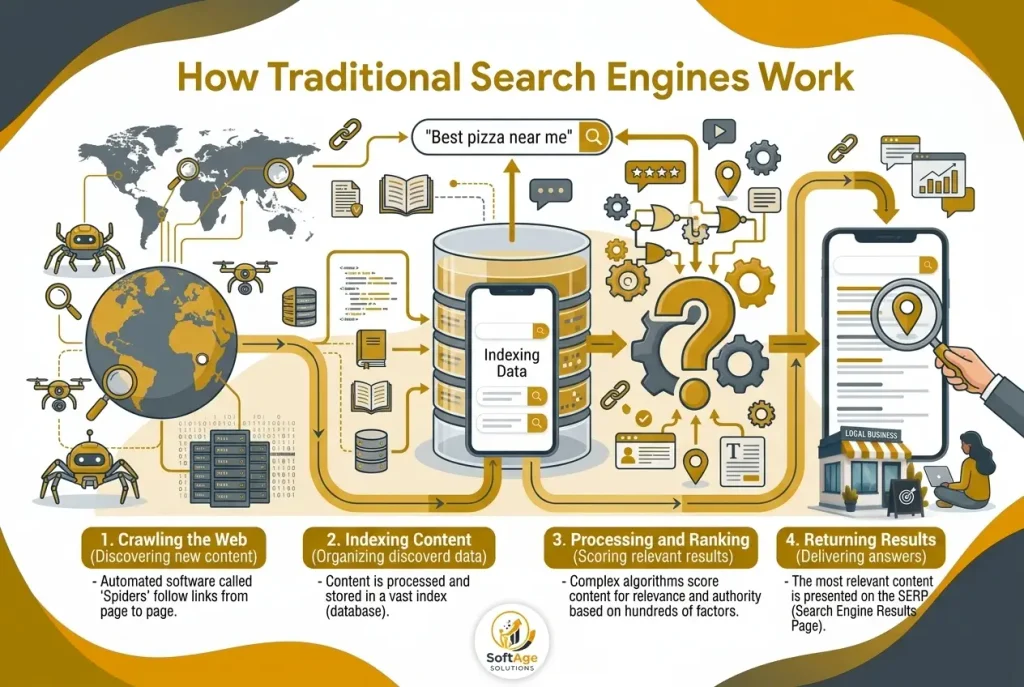
How Traditional Search Engines Work
At a high level, a search engine follows these steps:
- Crawling. Automated programs visit web pages by following links and reading sitemaps.
- Indexing. The search engine stores and organizes what it finds.
- Understanding content. It reads the text, images, and structure to work out what each page is about.
- Matching. When someone searches, it looks for pages that fit the meaning of the query, not only the exact words.
- Ranking and display. It orders results using many signals and shows them, sometimes with snippets, images, or maps.
- The click. The person picks a result and visits the website.
Not every page gets crawled, indexed, or shown. Google states plainly that meeting its requirements does not guarantee indexing or serving.
Core SEO Strategies and Tactics
Here are the main SEO areas and what each one does:
- Search intent. This is the reason behind a search. Someone who types “what is a CRM” wants an explanation. Someone who types “CRM pricing” is comparing options. Matching your page to intent is the basis of good SEO.
- Keyword research. You find the words and phrases people use, so your pages use language that matches real searches.
- Topic research. You look beyond single keywords to the related questions and subtopics a reader expects to see covered.
- Helpful content. Pages written for people, with accurate information and original value, are the center of SEO.
- On page SEO. This covers page titles, headings, and clear writing that tell readers and search engines what a page is about.
- Internal linking. Links between your own pages help people and crawlers find related content.
- Technical SEO. This covers crawlability, indexing, site structure, and fixing errors so search engines can reach your pages.
- Mobile usability and page performance. Pages should work well on phones and load quickly.
- Image SEO. Good file names, alt text, and image quality help images appear in search and support the page.
- Structured data. Extra code that describes your content to search engines. It can make a page eligible for some rich results.
- Backlinks and references. Links from other trusted sites can show that others find your content useful.
- Local SEO. For businesses that serve a specific area, local search work covers things like Google Business Profile and local listings.
- E-E-A-T and content quality. E-E-A-T stands for experience, expertise, authoritativeness, and trustworthiness. It is a way to think about whether people can trust a page. It is not a single score.
Understanding GEO| Generative Engine Optimization
Generative Engine Optimization is the practice of making your content easier for generative AI systems to understand and use in their answers. The word “generative” refers to the fact that these systems write a new response instead of only listing links.
The term became known through a research paper called “GEO: Generative Engine Optimization,” presented at the KDD 2024 conference. The authors tested content changes, such as adding citations, quotations from relevant sources, and statistics, and reported visibility gains of up to 40 percent in their experiments. That is useful research. It is not a promise that the same changes will give the same gain on your site or on every platform.
Companies use the term too. Microsoft, for example, describes its AI Performance report in Bing Webmaster Tools as an early step toward GEO tooling.
GEO relates to AI powered search because generative systems often pull facts from several sources and combine them into one response. Content that is clear, factual, and well-organized is easier for a machine to read and use.
GEO is not a separate replacement for SEO. The two share a lot. A page that search engines cannot crawl or index will usually have little chance of being used by a search-based AI feature. A page that is thin or copied has little to offer either channel.
How AI-Powered Search Works
The details differ from one platform to the next. In general, a generative search system may do some of the following:
- Interpret the question. It works out what the person wants, including related needs.
- Retrieve information. It finds relevant pages or other sources. Google describes a technique called retrieval-augmented generation, also called grounding, where its AI features rely on core Search ranking systems to find current pages.
- Search several angles. Google also describes “query fan out,” where the system runs a set of related searches on subtopics to build a fuller answer.
- Process sources. It reads information from different pages and compares or combines it.
- Write a response. It produces an answer in natural language.
- Show links or citations. Some experiences show source links. Others show fewer or none.
- Answer without a click. In some cases, the person gets what they need and never visits a website.
Here is what the public documentation says about a few platforms:
- Google AI Overviews and AI Mode. Google says these features use its Search index and ranking systems. It also says AI Mode and AI Overviews may use different models and techniques, so the links they show will vary.
- ChatGPT. OpenAI says any public website can appear in ChatGPT search. It asks site owners not to block its search crawler, called OAI-SearchBot, if they want to be included in summaries and snippets. GPTBot is a separate crawler tied to training.
- Microsoft Copilot. Bing Webmaster Tools now reports when a site is cited in Copilot, in AI-generated summaries in Bing, and in some partner integrations.
- Perplexity. Perplexity says its PerplexityBot is built to surface and link websites in its search results. A second agent, Perplexity-User, supports user actions and generally ignores robots.txt rules.
- Google Gemini. Behavior can differ by product and over time. Check Google’s current documentation for the experience you care about.
These systems do not operate identically, and they change often. No checklist can promise that your content will appear in an answer.
Essential GEO Tactics for AI Visibility
These practices may improve the chance that your information is understood and used by generative systems. None of them is a guarantee.
- Answer questions directly. Put a clear answer in the first sentence under a heading, then add detail.
- Use clear headings. Headings that match real questions help readers and machines find the right part of a page.
- Give concise definitions. If your page uses a term, define it in plain words.
- Cover the topic completely. Include related questions, steps, and common concerns, so the page answers more than one angle.
- Support claims with reliable sources. Name the source and keep the claim accurate. The GEO research paper found that citations and statistics were among the changes that helped in its tests.
- Show firsthand experience where it is real. Google says original content with a unique point of view is likely to matter more over time than other tactics in its guide. Do not invent experience you do not have.
- Keep facts accurate and current. Update pages when details change.
- Use clear names and terms. Name the product, place, person, or concept the same way each time. This helps with entity optimization, which means making it clear what or who your content is about.
- Build topical relevance. Publish connected pages on a subject so your site shows real depth. This supports topical authority.
- Structure information logically. Use short sections, lists, and tables when they make the page clearer.
- Add useful examples. Examples make an explanation easier to understand and harder to confuse.
- Keep the site accessible and crawlable. Allow the crawlers you want to reach your pages and make sure important text is available as text.
- Build trust. Show who wrote the page, who runs the business, and where facts come from.
A note for Google Search specifically. Google says you do not need new machine-readable files such as llms.txt, you do not need to break content into tiny pieces, and you do not need to rewrite content only for AI. It also says chasing inauthentic mentions is less helpful than it may seem, and that there is no special schema you must add. You may still choose to do some of these for other services. Just know that Google says they will neither help nor harm your visibility there.
SEO vs GEO: Key Differences
SEO and GEO differ in where they aim, what they measure, and how visibility looks. This section compares them without declaring either one better.
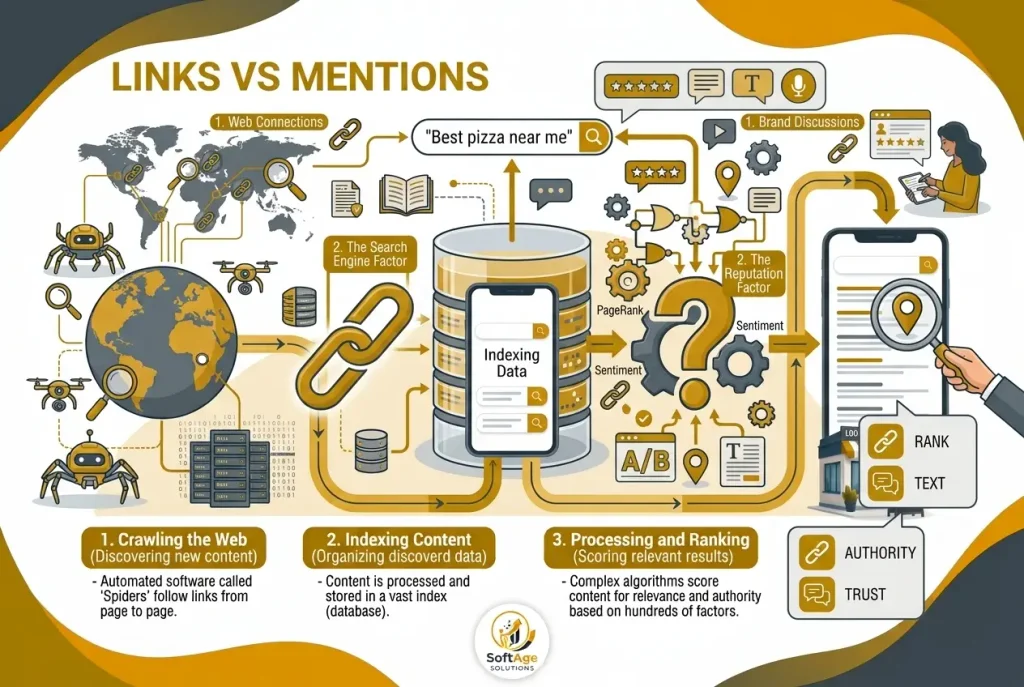
Links vs Mentions: An Important Difference Between SEO and GEO
In traditional search, the goal is usually visibility in the results and a click to your website.
In generative search, your information may show up in a few different ways:
- A mention. An AI answer names your brand or business in the text.
- A citation. The answer shows a link or source reference pointing to your page.
- Use without credit. Your information may shape an answer without being named.
A mention and a citation are not the same thing. A brand can be named without a link, and a link can appear without the brand being named in the text. Platforms also show sources in different ways. Some show a list of links, some show a few inline references, and some show little. Do not assume what you see on one platform applies to another.
Click Through Search vs Zero Click Search
In traditional search, a person sees a result and clicks to a website. In generative search, the person may get an answer on the spot, which can reduce the need to click for some questions.
Research gives a partial picture. Pew Research Center analyzed browsing data from 900 US adults in March 2025. It found that people who saw a Google AI summary clicked a traditional result link in 8 percent of visits, compared with 15 percent of visits without a summary. That is one study, from one country and one month, and it covers one search engine. Google has said that clicks from pages with AI Overviews tend to be higher quality, meaning people are more likely to spend more time on the site.
User behavior varies by query and by platform. Not every generative search ends without a click. Simple fact questions may be answered on the spot, while research and comparison questions often lead people to read sources.
SEO vs GEO Comparison
| Area | SEO | GEO |
|---|---|---|
| Main purpose | Help pages appear in search results and earn visits | Help information be understood and used in AI-generated answers |
| Primary environment | Search engine results pages | AI answers in search features, chat tools, and assistants |
| Content focus | Pages matched to search intent | Clear, accurate, well-sourced information that is easy to retrieve and summarize |
| Search behavior | People scan a list of results and choose | People read a written answer and may ask follow-up questions |
| Visibility type | Rankings, snippets, and listings | Mentions, citations, or use inside an answer |
| Website traffic | Clicks from results are a main outcome | Clicks may happen, but not always |
| Brand mentions | Possible, but not the main measure | A common point of interest |
| Citations | Not a core concept | Shown on some platforms, in different ways |
| Content structure | Clear headings, titles, and internal links | Clear headings, direct answers, and organized facts |
| Measurement | Search Console, analytics, rankings | Platform reports where they exist, manual checks, referral traffic, and monitoring |
| Time horizon | Often builds over months | Varies and is hard to predict |
| Relationship | Foundation for search visibility | Overlaps with SEO and adds focus on generated answers |
Optimization Timeline
Neither SEO nor GEO has a fixed timeline. Anyone who promises results in a set number of days or months is guessing.
Several factors affect progress:
- Website authority and history
- Competition for the topic
- Content quality and depth
- Technical condition of the site
- Demand for the topic
- Search behavior in your market
- Changes made by search and AI platforms
- How often you publish and how good the work is
SEO changes can take a while to show because pages must be crawled, indexed, and judged. GEO changes are harder to track because AI answers can vary from one query and one day to the next.
Measurement Approaches
For SEO, common measures include:
- Organic impressions and clicks
- Search rankings
- Organic traffic
- Indexed pages
- Conversions and leads
- Engagement, such as time on page
- Branded search activity, which shows how many people look for your name
For GEO, you can make useful observations, but the data is still developing:
- AI mentions. Check whether your brand is named when you ask relevant questions on different platforms.
- AI citations where visible. Note when your pages are linked as sources.
- Referral traffic from AI platforms where measurable. OpenAI says ChatGPT adds the parameter utm_source=chatgpt.com to referral links, so analytics tools can pick up that traffic.
- Platform reports. Google points site owners to a Generative AI performance report in Search Console. Bing’s AI Performance report shows citations in Copilot, Bing AI summaries, and some partner integrations. As reported at launch, it shows citations but does not show click data.
- Query level monitoring. Track a set of important questions over time.
- Changes in branded demand. See whether more people search for your name.
Be clear about the limits. GEO measurement is still developing, and platform data is not always complete or available. There is no universal GEO metric. Google also warns about third-party tools that claim to use internal Google data, because no outside tool has access to its internal ranking or AI systems.
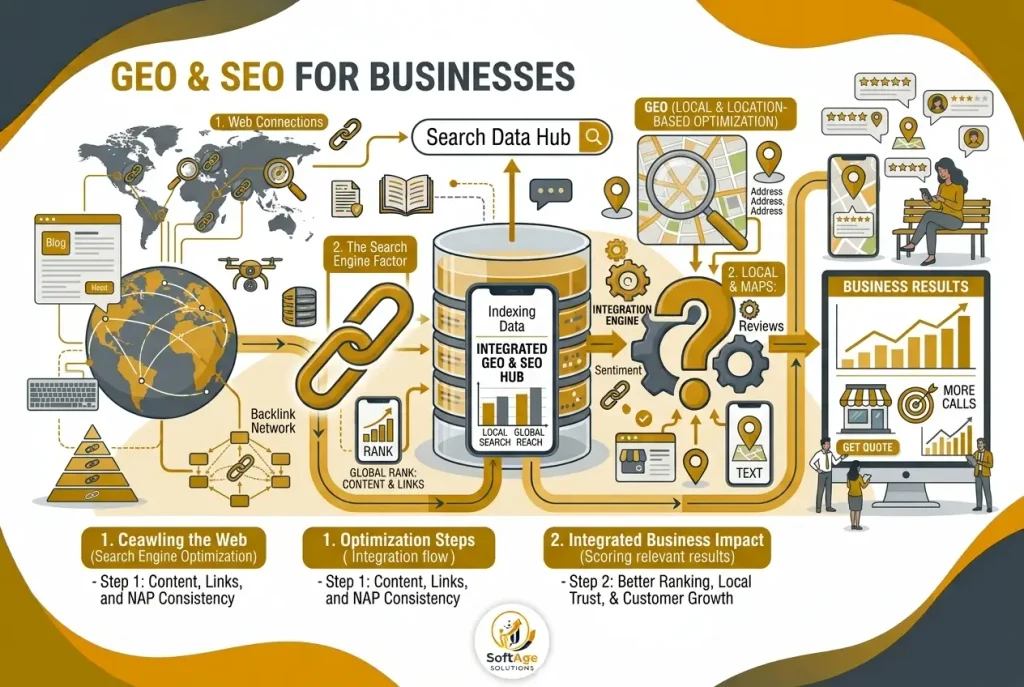
How SEO Supports GEO
SEO and GEO share a lot of groundwork. Good SEO supports content discovery and understanding, and GEO adds attention to how information may be used in generated answers.
- Search accessible content. If search engines cannot reach or index a page, search based AI features cannot use it. Google says a page must be indexed and eligible to show with a snippet to appear as a supporting link in AI Overviews or AI Mode.
- Crawlability. Make sure robots.txt and your hosting setup do not block the crawlers you want.
- Clear site architecture. Internal links and logical menus help systems find related pages.
- Strong topical coverage. Deep, connected content on a subject shows that your site knows the topic.
- Helpful content. People first writing is the base of both.
- Reliable information. Accurate, current facts matter in every channel.
- Author credibility. Clear authorship and real expertise build trust.
- External references. Mentions and links from other trusted sources support your reputation.
- Structured content. Headings, lists, and tables make pages easier to read.
- Good user experience. Fast pages, a clean layout, and a site that works on every device help people stay. This starts with sound web development.
SEO does not automatically produce AI citations. Many well ranked pages never get cited, and AI systems may pick sources in ways that differ from a normal ranking.
How to Create Content for Both SEO and GEO
Use this process for each important page:
- Identify the user’s search intent. Decide what the person is trying to learn or do.
- Research the topic and related questions. Look at search results, People Also Ask style questions, and customer emails.
- Define the main entity or topic. State clearly what the page is about, using the same name throughout.
- Create a clear content structure. Plan headings that follow the reader’s questions.
- Answer the main question early. Give a direct answer in the first few sentences.
- Cover related subtopics. Add the next questions a reader would ask.
- Use descriptive headings. A heading should tell the reader what the section contains.
- Add examples and explanations. Show how an idea works in a real situation.
- Support factual claims. Link to or name a reliable source.
- Improve internal linking. Connect the page to related pages on your site.
- Check technical accessibility. Confirm the page is indexable, loads well, and shows its text in the page code.
- Keep information current. Review the page on a schedule and update facts.
- Review the content for accuracy. Have someone with real knowledge check it.
- Monitor search and AI visibility where measurable. Use Search Console, analytics, and manual checks of key questions.
Why Businesses May Need Both SEO and GEO
Not every business needs both equally. A plumber who gets most work from local searches may put more weight on local SEO. A software company that people research through chat tools may care more about how AI tools describe it.
A business may gain from:
- Search visibility for people who search directly.
- Website traffic from organic results.
- Brand discovery when new people first learn about you.
- Direct answers in AI systems when your information fits a question.
- Brand mentions that build awareness.
- Source citations where available, which can send readers to your site.
- Strong topical authority, which supports both channels.
- Better content accessibility, which helps users and machines.
The right mix depends on:
- Business goals
- Audience behavior
- Industry
- Search demand
- Content type
- Existing website strength
- Available time and budget
Start with the channels where your customers actually look for answers. Then add effort as your resources allow.
Practical SEO and GEO Strategy for Small Businesses
A small business can start with a simple plan. You do not need special tools to begin.
Start With Search Intent
List the questions customers ask before they buy. Check your emails, calls, chat messages, and reviews. Then look at search results for those questions to see what kinds of pages appear. This tells you what people want and what format fits.
Build Useful Topic Pages
Create one page for each real customer question or service topic. Give each page a clear answer, plain explanations, and examples from your work. Good content writing starts with real questions and ends with pages a reader can trust. Avoid making dozens of near copies of a page for tiny keyword variations. Google’s spam policies treat creating content mainly to manipulate rankings or generative AI responses as scaled content abuse.
Improve Existing Content
Review pages that are thin, old, or unclear. Add direct answers, fix outdated facts, add sources, and remove filler. Improving a weak page is often faster than writing a new one.
Strengthen Internal Links
Link related pages together with descriptive anchor text. A service page can link to a guide, and a guide can link back to the service. This helps readers and search systems understand how your content fits together.
Build Trust
Show who is behind the content and the business. Useful trust signals include:
- Author names and short bios where it makes sense
- Business details, such as address and registration if applicable
- Contact information that works
- References for facts
- Reviews, where relevant and genuine
- First hand experience, described honestly
- Accurate claims, with no exaggeration
Monitor Results
Check Search Console for impressions, clicks, and queries, and look at the Generative AI performance report if it is available to you. Use Bing Webmaster Tools if Bing matters for your audience. Track referral traffic in analytics. Once a month, ask a set of key questions on a few AI platforms and note whether your brand or pages appear. Keep notes, because answers vary. Do not treat any single check as proof.
Common GEO Mistakes
- Treating GEO as a replacement for SEO. Keep your SEO base in place and treat GEO as part of the same effort.
- Writing only for AI systems. Write for people first. Google says you do not need to rewrite content only for AI.
- Creating generic AI generated content. If a tool could produce the page in seconds, it adds little. Add real knowledge, examples, and original points.
- Making unsupported claims. Back up facts with reliable sources or remove them.
- Ignoring search intent. Match the page to what the person wants, not only to a keyword.
- Using vague terminology. Define terms and use consistent names.
- Failing to explain entities clearly. State who you are, what you offer, and where you work in plain words.
- Publishing outdated information. Review pages on a schedule and update facts.
- Chasing AI mentions instead of useful content. Mentions follow from being useful and credible. Google says seeking inauthentic mentions is less helpful than it might seem.
- Assuming one AI platform behaves like another. Check each platform’s own documentation and test separately.
- Using keyword stuffing. Repeating terms hurts readability and does not help understanding.
- Ignoring technical SEO. Fix crawling, indexing, and speed issues first.
- Measuring only rankings. Add clicks, conversions, leads, and AI visibility checks.
- Assuming AI visibility is guaranteed. No tactic promises it. Set goals around useful content and steady improvement.
Future of SEO and GEO
It helps to separate what is known today from what people expect.
Current facts.
- Google has added AI Overviews and AI Mode to Search, and it says these features are rooted in its core Search ranking and quality systems.
- Other platforms, including ChatGPT, Copilot, and Perplexity, offer search or answer features that cite web sources in their own ways.
- Platforms are adding reports. Google offers a Generative AI performance report in Search Console, and Bing offers AI Performance in Bing Webmaster Tools.
- Studies such as Pew’s show that clicking behavior can change when AI summaries appear.
Reasonable possibilities.
- More search experiences may combine links with written answers.
- Brand discovery may happen earlier, inside AI tools, before a person visits a website.
- Measurement may become clearer as platforms release more data.
- Source credibility and original content may matter even more as machine-written pages become common.
Nobody knows exactly how search will work in a few years. The safest approach is to keep building accurate, original, easy-to-access content and to keep reading official documentation as it changes.
Conclusion
SEO and GEO have a large overlap. SEO focuses strongly on search visibility and website discovery. GEO focuses on how information is understood and used inside generative search experiences. SEO can support GEO, and GEO does not automatically replace SEO.
Businesses should choose their focus based on their audience, goals, industry, and available resources. For most, the first step is the same: clear, accurate, original content on a site that search engines and AI tools can reach.
If you want help reviewing your website’s SEO foundation, content, or technical setup, SoftAge Solutions can help you look at where your site stands and decide what to work on first. We do not promise rankings, traffic, or AI citations. We focus on clear improvements that help your readers.
FAQs
What is the difference between GEO and SEO?
SEO helps a website appear in search results and earn visits. GEO helps information be understood and used in AI generated answers. They overlap a great deal, and Google treats work on its AI search features as part of SEO.
Do I need GEO if I already have a strong SEO strategy?
Not necessarily as a separate project. A strong SEO base already supports much of what GEO needs, such as crawlable pages and helpful content. You may add GEO-focused checks, like reviewing how AI tools describe your brand, if your audience uses them.
Does GEO replace SEO for digital marketing?
No. GEO does not replace SEO. Search engines still send visitors, and search based AI features rely on indexed content. Both belong in a wider plan.
What metrics should I track to measure GEO performance?
Useful signals include AI mentions, citations where visible, referral traffic from AI platforms, branded search changes, and results from platform reports such as Search Console’s Generative AI performance report and Bing’s AI Performance report. No single GEO metric works everywhere, and data is still limited.
How can small businesses start implementing GEO tactics?
Start by answering real customer questions clearly, supporting claims with sources, and keeping facts current. Make sure your site is easy to crawl and show who is behind the content. Then check how your brand appears in a few AI tools each month.
Are GEO and SEO the same thing?
Not exactly, but they overlap. SEO is the broader practice of improving search visibility. GEO is a newer term for work aimed at generative answers. Google says that, from its point of view, working on generative AI search is still SEO.
Does SEO help with GEO?
Yes, it can. Crawlable pages, clear structure, helpful content, and trust signals help both. SEO does not guarantee that an AI system will mention or cite you.
Can GEO increase website traffic?
It might in some cases, if an AI answer cites your page and a reader clicks. But generative answers can also reduce clicks for some questions. Results vary by query and platform, so no traffic gain should be assumed.
Can GEO guarantee AI citations?
No. No tactic can guarantee citations or mentions. AI systems choose sources in ways that differ by platform and can change at any time.
Is GEO a replacement for traditional SEO?
No. GEO builds on the same base as SEO. Treating it as a replacement can lead to neglect of crawling, indexing, and content quality, which AI features also depend on.