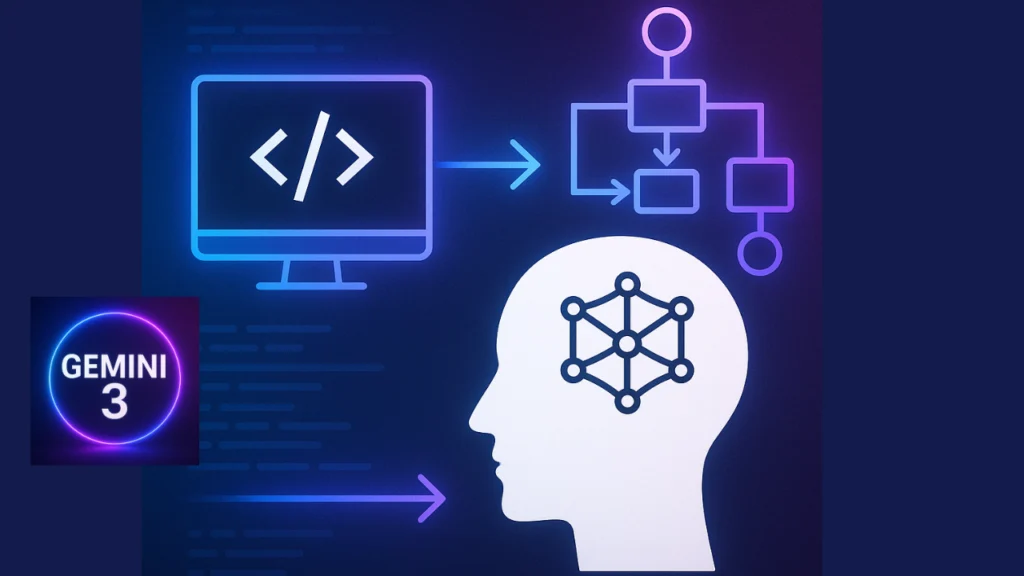
For developers, Gemini 3 represents a shift from basic AI coding assistance to full agentic workflows.
As software teams face tighter deadlines and rising complexity, the challenge has moved beyond writing syntax and into managing architecture, logic, and large-scale codebases. Google’s latest announcement, a dual release of Gemini 3 and the Antigravity agentic development platform, signals a major transition in how developers interact with AI.
Rather than simply accelerating coding tasks, Google now envisions a workflow where developers orchestrate autonomous agents capable of handling multi-step operations across entire projects. This marks a notable break from traditional chat-based assistants, pointing toward a future where AI becomes a delegated coworker rather than a reactive tool.
The reasoning engine: Gemini 3
At the center of this shift is Gemini 3, which Google positions as a foundational model for advanced agentic development.
According to Google’s technical benchmarks, Gemini 3 Pro achieved a 54.2% score on Terminal-Bench 2.0, a benchmark designed to test a model’s ability to operate a computer through terminal commands. This is a significant jump from the 32.6% score of its predecessor, Gemini 2.5 Pro.
More importantly for developers evaluating its coding potential, Gemini 3 Pro scored 76.2% on SWE-Bench Verified in a single attempt, indicating a major leap in multi-step problem-solving, repository navigation, and bug resolution.
These results suggest that Gemini 3 can perform long-horizon coding tasks that previous models either struggled with or failed to complete consistently.
A new economic model for AI in engineering
Gemini 3 Pro’s preview pricing poses a clear ROI question for enterprises: $2 per million input tokens, $12 per million output tokens, with prompts up to 200k context tokens.
- $12 per million output tokens
- Valid for prompts up to 200k context tokens
Engineering leaders must weigh token costs against the time saved from tasks such as refactoring, debugging, and boilerplate generation.
Context handling for enterprise-scale systems
Google emphasizes Gemini 3’s ability to retain context across entire codebases, an essential capability for large systems with legacy components.
The model is designed to manage:
- Multi-file refactors
- Long debugging sessions
- Feature implementation across interconnected modules
- Audits of decade-old legacy systems
This long-context memory is crucial for enterprise teams, where understanding cross-file dependencies can make or break productivity.
The vehicle: Google Antigravity
While Gemini 3 provides the intelligence, Antigravity acts as the operational platform that brings agent workflows to life.
Google argues that existing IDEs are not equipped for agent-first development. Antigravity aims to meet this need by providing a dedicated environment that streamlines orchestration of autonomous coding tasks, making it easier for developers to deploy, manage, and scale agentic workflows in real time.
From AI-assisted coding to AI-managed workflows
Whereas traditional IDEs keep developers in control with AI as an assistant, Antigravity shifts the dynamic by enabling AI agents to manage and execute tasks directly. This improves project efficiency and allows developers to focus on strategy rather than manual task coordination.
The platform introduces a Manager interface described as a mission control dashboard, where developers can:
- Spawn multiple agents
- Assign independent tasks
- Oversee parallel workstreams
- Monitor execution across different codebases.
This allows a single developer to oversee several workstreams simultaneously, for example:
- One agent analyzing API changes
- Another drafting UI components
- A third patching backend issues
This parallelization aligns with the broader industry movement toward agentic development.
Solving the transparency problem with Artifacts
A major barrier to adopting autonomous coding agents is trust. If an AI modifies code without clarity, it introduces risk, especially in sensitive sectors.
Google acknowledges the issue: most tools either show too much agent detail or too little, creating uncertainty.
Antigravity addresses this with Artifacts.
Artifacts are structured deliverables such as:
- Task plans
- Step-by-step reasoning
- Screenshots of agent actions
- Implementation blueprints
These let developers review and validate agent logic before code changes are applied.
In industries such as finance, medicine, and government, where compliance is strict, Artifacts provide a much-needed audit trail.
A built-in feedback loop
Developers can comment directly on these artifacts, and:
“This feedback will be automatically incorporated into the agent’s execution without requiring you to stop the agent’s process.”
This creates a steady, real-time correction mechanism, solving a major pain point in chat-based tools where interruptions often reset progress.
Freedom from vendor lock-in
In an unexpected but strategic move, Google allows Antigravity users to select from multiple AI models:
- Google Gemini 3
- Anthropic Claude Sonnet 4.5
- OpenAI GPT-OSS
This flexibility ensures teams can choose models based on language support, reasoning quality, or specific engineering tasks.
It also positions Antigravity as a neutral operations layer, rather than a closed ecosystem.
Support for modern developer tools
Gemini 3 Pro integrates across popular development environments:
- GitHub
- Cursor
- JetBrains IDEs
- Cline
- Manus
This allows teams to incorporate agentic workflows without disrupting existing pipelines.
We are not yet at full autonomy.
Google is transparent about the fact that AI agents are not ready to run for days without human intervention. Current agentic workflows remain a form of assisted autonomy, and human oversight remains essential.
Today’s capabilities:
- Complex debugging
- Parallel agent tasks
- Cross-file understanding
- End-to-end refactoring
Not yet possible:
- Fully independent deployment
- Multi-day runtime without checks
- Trustless execution in production
Still, the gap between supervised and unsupervised agents continues to shrink.
Vibe coding: natural language as the only syntax
One of the most intriguing additions is vibe coding, where developers describe an application in natural language, and Gemini 3 generates a working prototype.
While impressive, this introduces governance challenges:
- Security risks
- Compliance violations
- Data privacy issues
- Lack of standardized code review
Enterprises will need internal frameworks before deploying Vibe coding at scale.
A shift in developer responsibilities
With agent-first workflows, the developer role evolves:
Old role:
- Write syntax
- Perform manual debugging
- Implement features by hand.
New role:
- Design system-level workflows
- Manage agents
- Validate AI-generated logic
- Architect software rather than typing it
Engineering becomes more about supervision and system design than low-level coding.
scaling productivity via parallel execution
Gemini 3 and Antigravity signal a future where productivity gains come not just from AI writing faster code but from AI performing multiple tasks simultaneously.
This enables teams to:
- Scale output without scaling headcount
- Reduce time spent on repetitive tasks.
- Modernize legacy systems
- Accelerate feature releases
- Improve code quality through structured oversight.
The key determinant of success will be how well these tools handle messy, real-world enterprise code, not just clean greenfield projects.
Conclusion
Google’s release of Gemini 3 and Antigravity represents a pivotal shift toward agentic development. With long-horizon reasoning, multi-agent orchestration, artifact-based transparency, and cross-model flexibility, the tools position themselves as a new foundation for modern engineering workflows.
While full autonomy isn’t here yet, the foundation is strong—and 2025 will likely be the breakout year for real-world adoption of AI-driven agentic development.
FAQs
1. What is Gemini 3?
Gemini 3 is Google’s latest-generation AI model in the Gemini family. It’s designed to offer advanced multimodal capabilities, stronger reasoning, and improved compatibility across devices and applications.
2. How is Gemini 3 different from previous versions?
Compared to earlier Gemini models, Gemini 3 typically provides:
- Faster response times
- Better accuracy in reasoning tasks
- Enhanced multimodal performance (text, image, audio, and more)
- Improved support for mobile and edge devices
3. What can Gemini 3 be used for?
Gemini 3 can be used for content creation, coding assistance, chat-based tasks, translation, summarization, image analysis, data insights, and powering apps with AI capabilities.
4. Is Gemini 3 free to use?
Google usually offers both free and paid tiers across platforms (e.g., Google AI Studio, third-party apps, Android integrations). Specific pricing may vary.
5. Does Gemini 3 support multimodal inputs?
Yes. Gemini 3 is designed to handle multimodal inputs, including text, images, audio, and document formats.
6. Can developers integrate Gemini 3 into their apps?
Yes. Google provides APIs and tools through Google AI Studio and the Gemini developer platform for app and workflow integration.
7. Is Gemini 3 safe for teens/students?
Yes. Gemini includes safety layers and filtered models suitable for general use, although educators and parents should still supervise usage where needed.
8. What devices support Gemini 3?
Gemini 3 models often run across:
- Web platforms
- Android devices
- ChromeOS
- Cloud platforms via API
9. Does Gemini 3 work offline?
Some lightweight versions, such as Gemini Nano-based variants, may support offline or on-device functionality, depending on device capabilities.