
Imagine this: your website targets one keyword per page, you build links, you optimise title tags, and yet you keep seeing modest results. Meanwhile, one competitor writes longer, richer articles and starts ranking for dozens of related search terms. What’s happening? The difference lies in understanding semantic SEO, not just matching keywords, but aligning with meaning, context, and user intent.
In this article, we’ll explore what semantic SEO is, how it works, why it matters, the techniques for implementing it, real-world examples, common mistakes to avoid, and what the future holds. Whether you’re a beginner or a seasoned content strategist, you’ll walk away with a clear roadmap to move from keyword‐focused optimisation to topic‐driven authority.
Meaning of Semantic SEO
What is Semantic SEO?
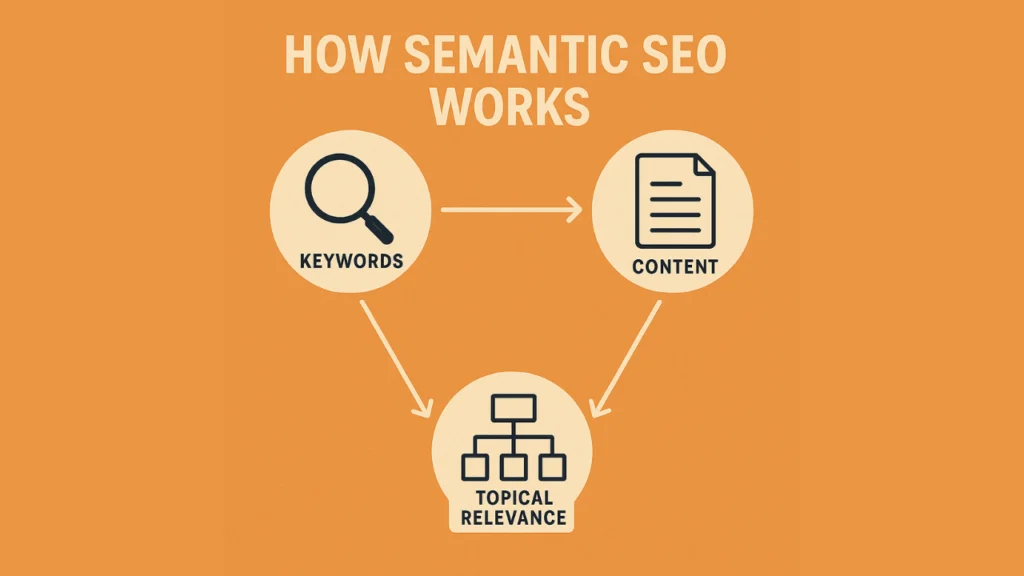
The term semantic SEO refers to optimising content not just for individual keywords but also for the topic, context, relationships between terms, and the user intent behind a query. According to the SEO platform SE Ranking, “Semantic SEO is the process of optimising your content for a topic rather than a single keyword or phrase. It looks into user intent, user experience, and the relationships between related entities and concepts.” SE Ranking
In other words, instead of asking “What exact keyword am I going to rank for?”, you ask “What question is the user really asking? What sub-questions surround it? What entities and concepts are involved?” The blog at Ahrefs puts it like this: “Semantic SEO is about showing up in search engines and LLMs that surface content or create responses based on meaning rather than word strings.” Ahrefs
Why the word “semantic” matters
The word “semantic” comes from “meaning” (semantics). While traditional SEO was largely about matching words, literal keywords, and exact phrases, semantic SEO is about meaning. For example, if someone searches for “running shoes”, semantically the engine might understand “athletic sneakers”, “trainers”, “running sneakers for men”, and so on. WordLift describes it as giving “more meaning and thematic depth to web content”.
Also, important search engine updates, like Google Hummingbird in 2013, signalled this shift: Google began understanding queries more like a human would, with context, entities, and intent.
How It Works and Its Components
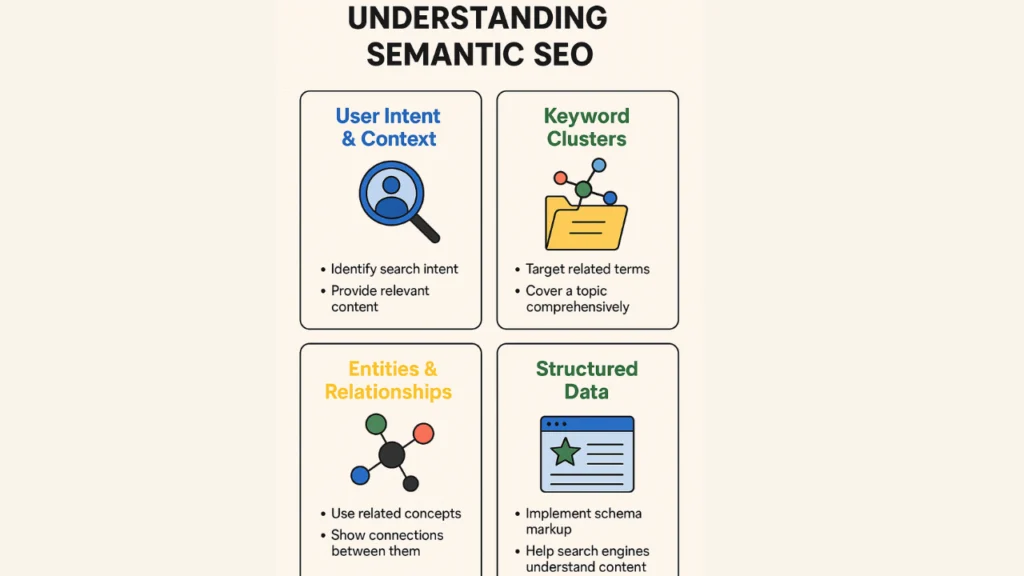
Core components of semantic SEO
There are several key building blocks that together make up a semantic SEO strategy:
- User Intent & Context: Understanding why someone is searching. Is it informational (“what is semantic SEO”), navigational (“semantic SEO tools”), or transactional (“hire semantic SEO consultant”)? Matching intent matters.
- Entities and Relationships: Modern search engines use knowledge graphs (for example, Google’s) to recognise entities (people, brands, places, topics) and their relationships. You optimise by building content that establishes those relationships. Search Engine Journal+1
- Keyword Clusters / Topic Coverage: Rather than one keyword, you cover a cluster of related terms, synonyms, LSI (latent semantic indexing) keywords, and sub-topics. Neil Patel’s article: “The combination of intent and topical relevance” is key.
- Structured Data & Mark-up (Schema): Using schema markup, you signal to search engines the structure and meaning behind your content. This helps machines interpret page elements, authorship, topic relevance, etc.
- Content Hierarchy and Internal Linking: A well-structured site where pages interrelate (via internal links) demonstrates topical authority and helps search engines understand the breadth and depth of coverage.
The flow of semantic SEO optimisation
Here’s a “workflow” style breakdown of how semantic SEO typically works:
- First, research the central topic and the main question the audience has.
- Then map out related sub-topics (the semantic cluster) using tools, SERP data, “People also ask,” and “Related searches.”
- Create content that covers not just the answer, but the why, the how, related questions, alternatives, and deeper context.
- Use proper H1/H2/H3 structure, integrate synonyms and related terms naturally (not forced).
- Implement schema markup (e.g., FAQ schema, article schema) and ensure the page is technically crawlable.
- Internally link to other relevant content on your site to signal depth and build a topic-cluster architecture.
- Monitor performance and update outdated content by adding semantic keywords, new insights, etc.
Benefits and Importance
Why semantic SEO matters
There are several compelling reasons to shift to semantic SEO:
Firstly, search engines like Google LLC increasingly understand language, context, and intent — not just keywords. Fortunately for your website, that means applying semantic SEO gives you a competitive advantage. Search Engine Journal says: “By creating semantically- and topically-rich content… site owners are more likely to build topical authority in their industry.” Search Engine Journal
Secondly, semantic SEO improves user experience. When you anticipate related questions and provide comprehensive answers, users stay longer, engage more, bounce less — which are positive signals to search engines.
Thirdly, you get broader keyword visibility. A page optimised around a topic and its semantic variants will likely rank for multiple related queries, rather than just one target keyword. Team WTI puts it simply: “Rank for a larger number of keywords · Potentially rank for a longer period of time.”
Finally, you build topical authority and trust. Over time, search engines will recognise your brand or site as a go-to resource for a subject, which can lead to better placement, featured snippets, entity recognition, and more.
Why brands should care
For marketers and content strategists, shifting from keyword-centric to topic-centric means better alignment with modern SEO realities. If you keep treating SEO as it was in 2010 (exact-match keywords, minimal context), you risk falling behind. As Ahrefs notes: “Where brand strategy overlaps with technical and on-page SEO, and that overlap is growing.” Ahrefs
In addition, semantic SEO supports other important marketing goals: diversifying organic traffic, enhancing content discoverability (including via voice search and AI), and reducing dependence on narrowly targeted keywords that may shift or decline in value.
Techniques, Tools, and Implementation Steps
Step-by-step implementation
Here’s a practical sequence to implement semantic SEO for a piece of content:
1. Topic research and mapping
Start by selecting a broad topic you want to own (for example, “semantic SEO”). Use keyword research tools to find related queries and cluster them (e.g., “what is semantic SEO”, “semantic search vs keyword search”, “semantic SEO tools”, “semantic SEO examples”). Also check SERP features, People Also Ask, and “related searches”.
2. Intent classification
For each query, determine user intent: informational, navigational, transactional, or commercial. This helps you decide content type (blog post, guide, tool, comparison) and structure accordingly.
3. Content outline creation
Build an outline that covers the main question and then the sub-questions (semantic cluster). Use H2s and H3s to reflect these sub-topics. This improves topical breadth and shows search engines the depth of your coverage.
4. Write with synonyms, entities, and natural language
Write in a conversational tone but include the related terms naturally (for example, “semantic search”, “latent semantic indexing”, “topic clusters”, “entity-based optimisation”). Avoid forced repetition of a single keyword.
5. Schema markup & structured data
Implement the relevant schemas: Article schema, FAQ schema, and How-To schema. These help search engines parse your content and sometimes display rich results (snippets). Neil Patel emphasises this.
6. Internal linking strategy
Link to other relevant pages on your site (for example: you have a main page “Semantic SEO”, then sub-pages “Semantic SEO tools”, “Semantic SEO examples”, etc.). This builds topical authority and site architecture.
7. Monitor and update
After publishing, track performance (traffic, rankings, user signals). Also, refresh your content periodically, add new semantic keywords, update facts, and add related questions. Neil Patel’s strategy #1 is “Update old content”.
Tools you can use
- Keyword research & clustering: tools like Ahrefs, SEMrush, Ubersuggest (as cited by Neil Patel)
- Schema markup/structured data helpers: Google’s Structured Data Markup Helper, WordPress plugins like Yoast or RankMath.
- Topic research: check SERP features, People Also Ask, “related searches”, and entity tools like WordLift (as referenced in the blog)
Quick checklist
- Does the content answer the main user question and the related questions?
- Are you using synonyms, related entities, and natural language?
- Is there a logical flow of H2/H3 headings covering topic breadth?
- Is schema markup implemented?
- Are internal links pointing to and from related topic pages?
- Will the page get updated or refreshed over time?
Real-World Examples or Case Studies
Let’s illustrate with two brief case-style examples (note: pseudonymised for clarity).
Example A: Blog post “Semantic SEO”
A marketing agency wrote a standard article simply targeting the keyword “semantic SEO”. It defined the term, then added a few bullet points and published. Result: moderate traffic, limited ranking climb.
Then they rewrote the post using semantic SEO, mapping out subtopics (semantic search vs. lexical search, how to find semantic keywords, semantic SEO tools, the future of semantic search). They integrated schema markup (FAQ), added internal links to other related articles on “topic clusters” and “entity-based optimisation”, used synonyms such as “topic-based SEO”, “entity- SEO”, “semantic keywords”. Within six months, they saw:
- Increase in long-tail keyword rankings (ranked for dozens of related queries)
- Longer average time on page
- Reduction in bounce rate
- Growth in organic traffic by ~35%
Example B: E-commerce product category optimisation
An e-commerce site selling running shoes switched from focusing solely on the keyword “running shoes” to covering the broader topic cluster: “running shoes for beginners”, “trail running shoes vs road running shoes”, “how to choose running shoes”, “running shoes for flat feet”, “top brands running shoes 2025”. They also used schema markup for products and reviews, linked to blog posts on “running shoe tech” and “running shoe maintenance”. As a result:
- They ranked not just for “running shoes” but for many niche queries.
- Their brand page began to appear in “people also ask” results.
- They captured featured snippets and shopping carousel placements.
These examples underscore that semantic SEO is less about a single keyword and more about owning a topic space with coherent, interlinked content.
Comparisons or Differences (if relevant)
Semantic SEO vs Traditional Keyword-Focused SEO
| Focus | One keyword per page | Topic + cluster of related terms |
| Language | Exact-match keywords, sometimes forced | Natural language, synonyms, intent-driven |
| Structure | Flat pages, minimal internal linking | Interlinked topic clusters, content hub model |
| Success metric | Rank for main keyword | Rank for multiple queries, establish authority |
| User intent | Often implicit | Explicitly analysed and matched |
| SEO signals | Keyword density, backlinks mainly | Entities, context, topical depth, internal architecture |
Why this difference matters
Traditional methods still work to some degree, but they increasingly fall short as search engines evolve. Search engines use natural language processing (NLP) and machine learning; they’re better at understanding meaning, not just word matches. SEMrush’s blog defines semantic search as “the process of how search engines understand and match keywords to a searcher’s intent in organic search results.” Semrush
Thus, if you only optimise for an exact keyword and miss out on the broader context, you’ll likely capture fewer long-tail keywords, weaker engagement, and less lasting authority.
Common Mistakes or Myths
Myth: More keywords = better ranking
One of the biggest misconceptions is that stuffing as many keywords as possible or targeting every possible variation will automatically boost ranking. In fact, focusing on meaningful content that covers the topic thoroughly is far more effective. Neil Patel: “Instead of focusing only on that keyword, you should aim to incorporate variations and long-tail phrases that reflect different aspects of your audience’s intent.”
Mistake: Ignoring user intent
If you write content that targets a keyword but doesn’t match what the user is really after, you risk high bounce rates and poor ranking signals. For example, a user searching “semantic SEO benefits” expects an informative piece—not a product page.
Mistake: Thin content or shallow topic coverage
Semantic SEO demands depth. If you create a 300‐word article and fail to cover the sub-questions surrounding your topic, you lose an opportunity. Search Engine Journal says longer, more comprehensive content sends stronger semantic signals. Search Engine Journal
Mistake: Ignoring internal linking and architecture
Covering topics in silos without connecting them makes it harder for search engines to see your site as an authority on the subject. Effective semantic SEO uses interconnected pages to build a network of relevance.
Mistake: Neglecting schema/structured data
Even well-written, comprehensive content might fall short if you omit structured markup. A schema helps search engines better understand your entities and relationships.
Future Trends or Predictions
The impact of AI and generative search
With the rise of large language models (LLMs) and generative search engines, semantic SEO is even more critical. A recent research paper on “Role-Augmented Intent-Driven Generative Search Engine Optimization” highlights how generative systems interpret content based on intent and roles, making topic depth and context more valuable than ever.
More emphasis on entity-based SEO
We’ll see search engines lean further into knowledge graphs and entity recognition, meaning content that emphasises entities (people, places, concepts) and their relationships will perform better.
Voice search and conversational queries continue to grow.
As more users speak queries rather than type, the need for content that addresses natural language and full conversational questions (rather than single keywords) grows. Semantic SEO aligns well with that shift.
Topic-based site architecture as a norm
Instead of isolated pages, websites will adopt hub-and-spoke (pillar pages with cluster content) models to build topical authority across entire subjects.
More focus on content breadth over just depth
It won’t be enough to go deep; you’ll also need to cover all relevant sub-topics and answer the full set of user questions for a given subject. Search engines will reward websites that comprehensively cover a topic universe.
FAQs
What is the difference between semantic search and semantic SEO?
Semantic search is the process by which search engines like Google interpret queries based on meaning, context, and entities, not just keywords. For example, Google’s Knowledge Graph helps understand relationships between entities. Semrush+1
Semantic SEO is the strategy you adopt to align your content with semantic search. It’s about optimising for meaning, topic clusters, entities, and user intent rather than just keywords.
Do I still need to use keywords in semantic SEO?
Yes, keywords remain part of the foundation. But instead of focusing solely on one keyword, you treat it as a node within a larger topic cluster. You naturally integrate synonyms, long-tail variations, and related concepts. That way, you cover the topic comprehensively for both search engines and users.
How do I find semantic keywords or keyword clusters?
You can use keyword tools (e.g., Ahrefs, SEMrush) to identify related queries and long-tail variations. Look at SERP features such as “People also ask”, “Related searches”. Also consider entity-based tools and topic research to identify relevant sub-topics. Blogs by Neil Patel and SE Ranking offer more in-depth how-to guides.
How long does it take to see results from semantic SEO compared to traditional SEO?
There’s no guaranteed timeframe. Some changes (such as integrating schema or internal linking) may have effects sooner. Building full topic authority (covering a subject deeply, interlinking pages) can take several months. But the payoff is typically more sustained and organic traffic, fewer fluctuations, and broader keyword rankings.
Can small sites use semantic SEO, or is it only for large sites?
Absolutely, semantic SEO is beneficial for sites of all sizes. Even small sites can pick one topic, create a strong pillar page, then write 3-5 related cluster pages and link them. Over time, you build topical authority. The key is quality, relevance, and alignment of intent, not site size.
Conclusion
To wrap up: semantic SEO is no longer optional; it is essential in today’s search landscape. It’s about writing with meaning, not just keywords; building topic authority, not just chasing page 1 for one phrase; and designing content that aligns with how users think, search, and expect answers.
By shifting your strategy toward topics, entities, clusters, intent, and schema markup, you position your site to ride the wave of machine learning, natural-language processing, and modern search algorithms. So go ahead: audit your content, build your topic map, implement schema and internal links, refresh old assets, and commit to becoming the trusted authority in your niche.
Your action step: Pick one core topic you wish to own this quarter. Map out five related sub-topics. Create or optimise a pillar page. Add internal links. Implement schema. Then monitor the results and refine.
When you approach SEO this way with topic-depth, user-centric focus, and semantic strategy, you’ll see not just rankings but lasting authority and meaningful traffic.