
SEO content is content planned and written to answer what people search for, so the right readers can find it through search engines. A good page does two jobs. It gives a visitor a clear, accurate answer, and it gives search engines clear signals about what the page covers.
This guide explains SEO content in plain English. You will see how it relates to SEO, how it works, how to create it step by step and how to check whether it is doing its job. No one can guarantee rankings, so the focus here is on practical steps you can control.
What Is SEO Content?
SEO content is any page, article or resource created to meet a real search need and support search visibility. Blog posts, service pages, product pages, guides and FAQs can all be SEO content.
It is not text stuffed with keywords. Google says its ranking systems are designed to favor helpful, reliable information created to benefit people, not content made to manipulate rankings. Google’s guide to creating helpful, reliable, people first content says SEO can help when applied to people first content. So the best SEO content starts with the reader and then makes sure the page is easy for search engines to understand.
A short example. Imagine a plumbing company in Ohio. People search “how to fix a leaking faucet” and “emergency plumber near me.” The first search needs a how to guide. The second needs a service page with contact details and service areas. Both are SEO content, but they serve different needs. (This is an illustrative example, not a real client.)
What Is SEO?
SEO stands for search engine optimization. Google describes it as the process of making your site better for search engines. In practice, it means helping people find your pages in search results and helping search engines understand and show them.
At a basic level, search engines work in three steps:
- Crawling. Automated programs find pages by following links and reading sitemaps.
- Indexing. The search engine stores and organizes what it finds.
- Ranking. When someone searches, the search engine picks and orders the pages that seem most relevant and helpful.
SEO covers several areas:
- Content, which this guide covers.
- On page work, such as titles, headings and internal links. See our on page SEO service.
- Technical work, such as site speed, crawling and mobile use. See technical SEO.
- Off page work, such as links from other sites. See off page SEO.
So SEO is the wider practice, and SEO content is the part that deals with what the pages say and how they answer searches. Content alone does not decide rankings. Technical health, links, competition and the quality of the site all play a part. Google’s SEO Starter Guide is a good official overview.
How Does SEO Content Work?
SEO content works by matching a page to a need and making that match easy to see. Several elements support this.
- Search intent. The page answers what the searcher actually wants, whether that is a definition, a comparison, or a service.
- Topic relevance. The page covers the topic clearly and includes related points readers expect.
- Clear titles and headings. These tell readers and search engines what each section covers.
- Useful, accurate answers. Correct information builds trust and reduces the chance that readers leave.
- Internal links. Links to related pages help people find more and help search engines understand how your site connects.
- Readability. Short paragraphs, plain words and clear lists make a page easy to use.
- Technical setup. Pages must load, work on phones and be open to crawling. Good web development supports this.
- Maintenance. Pages stay useful when facts, prices and examples are kept current.
Following these practices can support visibility. It does not guarantee rankings, because results depend on the website, the competition, the implementation and other factors.
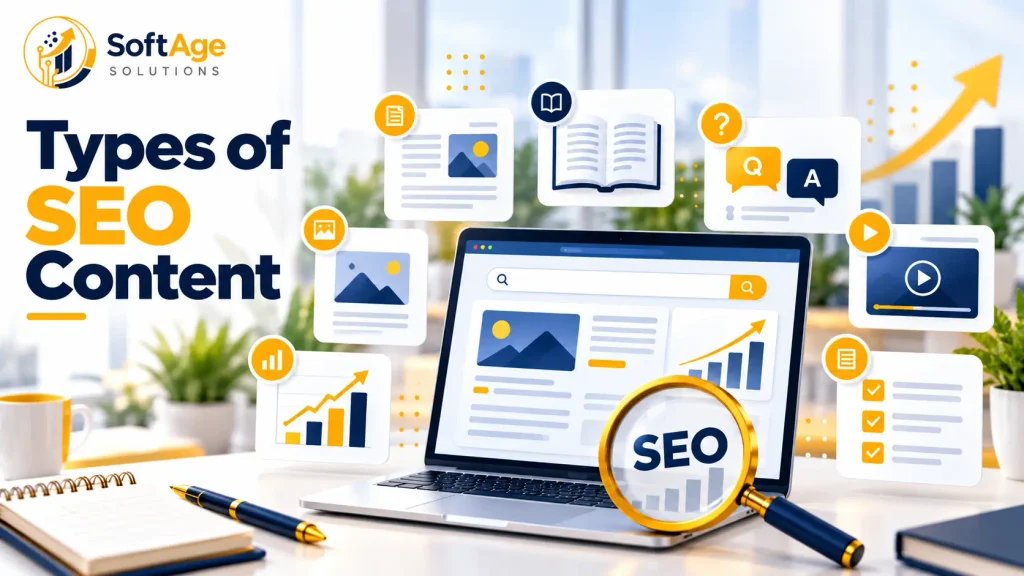
Types of SEO Content
Different goals need different formats. Do not create a page for every keyword. If several keywords share the same intent, one strong page is usually better than several thin ones.
Educational Content
- Blog posts and educational articles answer questions and build awareness. Use them when people are still learning about a topic.
- How to guides and tutorials teach a task step by step. They suit searches that start with “how to”.
- Comparison articles help readers choose between options. Use them when people are deciding.
- Glossaries define terms in a short, clear way.
- Resource pages collect useful links and tools on one topic.
Commercial and Local Pages
- Service pages explain what you offer, who it is for and how to start. They suit searches with buying intent.
- Product pages describe an item, its details and how to buy it.
- Category pages group related products or services and help people browse.
- Local service pages cover a service in a specific city or area. They work only when the business actually serves that area. Our local SEO service covers this kind of work.
Support and Proof Content
- FAQs answer common questions briefly and support other pages.
- Case studies show real work and results. Include them only when they are genuine and verified.
What Makes Content SEO Friendly?
SEO friendly content has these qualities:
- It answers a real audience question.
- It matches the intended purpose of the page, such as learning or buying.
- It gives accurate, relevant information.
- It uses clear headings and a logical structure.
- It includes relevant keywords naturally.
- It links to related pages when that helps the reader.
- It uses reliable sources for factual claims.
- It is easy to read and use.
- It is kept current when information changes.
Google’s guidance also asks creators to think about experience, expertise, authoritativeness and trustworthiness, often shortened to E-E-A-T. Showing who wrote the content, why they know the topic and where facts come from can help readers trust a page. None of this is a formula that guarantees results.
How to Create SEO Content Step by Step
Plan the Content
- Understand the audience. Who are they, what do they need, and what words do they use?
- Research the primary keyword. Find the main phrase that describes the topic.
- Review secondary and related keywords. Note related terms and questions people ask.
- Check search intent. Search the keyword and see what kinds of pages appear.
- Study competing pages. Look for what they explain well and what they miss. Do not copy them.
- Choose the topic and format. Pick the page type that fits the need, such as a guide or a service page.
- Create an outline. List the headings and the questions each section must answer.
Write the Content
- Write an accurate, original draft. Answer the main question early and keep paragraphs short.
- Add clear headings and natural keyword variations. Use words a reader would expect, not repeated phrases.
- Add internal links and reliable sources. Link to related pages and cite official or trusted sources for facts.
Publish and Review
- Review the title, meta description, and structure. Make sure they describe the page honestly.
- Check accuracy, readability, and technical details. Fix errors, broken links and unclear passages.
- Publish and watch performance. Check how the page appears and is used in search.
- Update when needed. Improve the page when facts change, or readers need more.
How to Do Keyword Research for SEO Content
Keyword research helps you find the words people use. It covers:
- The primary keyword, the main phrase for the page.
- Secondary keywords, closely related phrases that fit the same page.
- Related search terms, which you can find from search suggestions and related searches.
- Questions people ask, which often become headings or FAQs.
- Search intent, which tells you the type of page needed.
- Topic overlaps, where two keywords should share one page.
- Content opportunities, where existing pages leave questions unanswered.
Search volume is only one factor. Relevance, intent, business value, and your ability to give a useful answer matter just as much. A phrase with fewer searches can be a better target if it matches what you sell.
How to Match SEO Content to Search Intent
Search intent is the reason behind a search. Common types are:
| Intent | What the searcher wants | Example search | Suitable page |
|---|---|---|---|
| Informational | To learn something | what is seo | Guide, article |
| Navigational | To reach a specific site or page | SoftAge Solutions contact | Home or contact page |
| Commercial investigation | To compare options before choosing | best seo content tools | Comparison, review page |
| Transactional | To buy or hire | seo content writing services | Service or product page |
Do not assume a keyword has only one intent. Search it and look at the results. If the first page is full of how to guides, a sales page is unlikely to fit. If it is full of service pages, a long article may not meet the need.
SEO Content Structure and On-Page Elements
These elements help readers and search engines understand a page.
- H1 and subheadings. The H1 names the page topic. Subheadings divide it into clear parts.
- Title tag. The title that appears in search results. Keep it clear and honest.
- Meta description. A summary that can appear under the title. It does not directly decide rankings, but it can influence whether people click.
- Introduction. Give the answer or purpose in the first few lines.
- Paragraphs. Keep them short and focused on one idea.
- Lists and tables. Use them when information is easier to scan.
- Images and alt text. Add images that help the reader, with alt text that describes what is shown.
- Internal links. Point to related pages with clear anchor text.
- External citations. Link to reliable sources that support facts.
- Readable URLs. Short and descriptive, such as /seo-content.
Not every element directly raises rankings. They work together to make the page clear, usable, and understandable.
SEO Content for Different Page Types
The same structure should not be forced on every page.
- Blog articles teach or explain. They need depth, clear sections, and related links.
- Service pages explain what you do, who it is for, how the process works, and how to contact you. Keep them focused and specific.
- Product pages need accurate details, images, pricing information, and clear options.
- Local business pages need correct service areas, contact details, and real local information.
- Category pages need a short introduction and a clear way to browse items.
- Educational resource pages collect guides and references under one topic.
A good content writing process starts by deciding which type of page the reader needs.
How to Measure SEO Content Performance

Measure whether a page is reaching and helping the right people. Useful measures include:
- Impressions. How often the page appeared in search results.
- Clicks from search. How many people clicked through.
- Click-through rate. Clicks divided by impressions.
- Search queries. Which searches bring people to the page.
- Relevant organic visits. Visits from unpaid search, judged by quality, not only volume.
- Engagement indicators, where reliable, such as time spent or actions taken.
- Conversions and leads, where tracking is set up, such as form submissions or calls.
- Content-assisted outcomes, where measurable, such as pages visited before an enquiry.
Google Search Console is the main free tool for search impressions, clicks, and queries. A web analytics tool can add visit and conversion data. Always read numbers in context. A single metric, such as a ranking position, rarely tells the full story.
Common SEO Content Mistakes
- Writing only to insert keywords. Write for the reader and use keywords where they fit.
- Ignoring search intent. Check the results before choosing a format.
- Copying competing articles. Add your own information and clear explanations instead.
- Publishing thin or repeated pages. Combine pages that serve the same purpose.
- Using unsupported claims. Support facts with reliable sources.
- Overusing headings. Use headings to organize, not to repeat keywords.
- Creating pages with overlapping purposes. Give each page its own job.
- Ignoring internal links. Link related pages so readers and crawlers can find them.
- Forgetting outdated information. Review pages on a schedule.
- Using misleading titles. A title should match what the page delivers.
- Publishing AI-generated text without checking it. Review it for accuracy, originality and usefulness. Google says content quality matters more than how it was produced.
- Judging success only by rankings. Look at clicks, leads, and business results too.
- Making claims about ranking factors you cannot support. Share only what sources confirm.
How Often Should SEO Content Be Updated?
There is no fixed schedule. It depends on the topic, how fast information changes, how the page performs and how accurate it needs to be.
Update a page when:
- Statistics, rules, or policies have changed.
- Product or service details are out of date.
- Search intent has shifted, so the page no longer matches the results.
- Readers have important questions that the page does not answer.
- Examples or links no longer work.
- The page contains errors or obsolete advice.
Do not change a page only to make it look fresh. Real improvement matters more than a date change.
How SoftAge Solutions Can Help With SEO Content
SoftAge Solutions offers content writing and SEO services, including on page SEO, technical SEO, off page SEO, and local SEO. Where relevant, professional content support may include:
- Keyword and search intent research
- Content planning
- SEO focused article writing
- Service page content
- On-page content review
- Internal link recommendations
- Content reviews and updates
The right mix depends on your website, your audience, and your goals. The team does not promise specific rankings, traffic or leads, because those depend on many factors.
FAQs
What is SEO content?
SEO content is content created to answer what people search for and support search visibility. It can include articles, service pages, product pages, and guides.
What is SEO?
SEO is search engine optimization, the practice of making a site easier for search engines to find, understand and show. It includes content, on page work, technical work and links.
What are examples of SEO content?
Examples include a how to guide, a service page, a product page, a category page, an FAQ page and a glossary entry. Each matches a different search need.
How do you write SEO content?
Research the audience and keywords, check search intent, outline the page, write an accurate and original draft, add clear headings and internal links, then review and publish. Update it when needed.
What makes content SEO friendly?
It answers a real question, matches the page purpose, uses clear structure, includes keywords naturally, cites reliable sources and is easy to read.
Is SEO content the same as content marketing?
No. Content marketing is a wider approach to attracting and keeping an audience with useful content. SEO content is content planned to meet search needs. The two often overlap.
How do keywords fit into SEO content?
Keywords show what people search for. Use the main keyword and related terms where they fit naturally, in titles, headings and body text. Do not repeat them to force a result.
How long should an SEO article be?
It should be as long as it needs to be to answer the question well. There is no required word count. Check what searchers expect and cover the topic fully without filler.
How often should SEO content be updated?
When facts, services, or search intent change, or when readers need more. There is no fixed schedule.
Can AI be used to create SEO content?
Yes, but review it. Check facts, add real expertise, and make sure it is original and useful. Google focuses on the quality of the content, not how it was made.
How do you measure SEO content performance?
Use Google Search Console for impressions, clicks and queries, and an analytics tool for visits and conversions. Judge results over time and in context.
Does SEO content guarantee higher rankings?
No. Good content can support visibility, but rankings depend on competition, technical health, links and many other factors.
Conclusion
SEO content begins with the reader. Understand what people want to know, research the topic, answer the search clearly, and check the finished page for accuracy and quality. Treat SEO as the wider practice and SEO content as the part that makes your pages useful and easy to find.
Measure how pages perform, update them when facts change and avoid shortcuts. If you need help planning SEO content for your website, contact SoftAge Solutions to discuss your content goals.