
Chicago SEO marketing is the work of helping a business show up in search results when people in and around Chicago look for what it sells. It covers local search, website quality, content, links, and tracking. This guide explains what that work includes, how it is measured, and how to judge a provider before you hire one. No one can promise rankings, so this guide sticks to what is known and to questions worth asking.
Key Takeaways
- Chicago SEO marketing is a set of tasks that can improve how a business appears in organic search for people in the Chicago area.
- It can help local service businesses, online stores, B2B firms, and companies with several locations. Each needs a different plan.
- The main parts are local SEO, keyword research, on-page SEO, technical SEO, content, link building, and reporting.
- Google Business Profile, reviews, and consistent business details support local search visibility.
- Rankings alone do not show business value. Calls, leads, and sales matter more.
- When you compare an SEO company, look at scope, reporting, contract terms, and who owns your accounts.
What Is Chicago SEO Marketing?
SEO stands for search engine optimization. It is the practice of making a website easier for search engines to understand and more useful for the people who find it. When it works, a business can appear in organic results, the unpaid listings on a search page. Google explains the basics in its SEO Starter Guide.
Location changes the work. Someone searching for a roofer, an accountant, or a software vendor often wants a provider in or near Chicago. Search engines try to show results that fit that place. A business serving Chicago needs its website, its Google Business Profile, and its other online listings to say the same thing about where it works and what it sells.
SEO is different from paid advertising. With ads, you pay for clicks, and visibility stops when the budget stops. With SEO, you put effort into your site, your content, and your reputation. Results usually take longer to show, and no one can guarantee them.
SEO can support customer acquisition because it puts a business in front of people who are already searching. But the plan should follow the business goal. A firm that wants more calls from one part of the metro area needs a different plan than a store that sells across the country.
Chicago SEO Marketing Services
Most programs combine several kinds of work. Here is a quick view.
| Area | What it covers | Question it answers |
|---|---|---|
| Local SEO | Google Business Profile, citations, reviews, local pages | Do nearby customers find us? |
| Keyword research | Search terms, intent, local variations | What do people search for? |
| On-page SEO | Titles, headings, copy, internal links | Does each page match the search? |
| Technical SEO | Crawling, indexing, speed, mobile use | Can search engines read our site? |
| Content strategy | Service pages, guides, FAQs | Do we answer customer questions? |
| Link building | Relevant links and mentions | Do other sites trust us? |
| Competitor analysis | Gaps and opportunities | Where are others ahead? |
| SEO audit | Full site and search review | What is holding us back? |
| Reporting | Traffic, leads, conversions | Is the work paying off? |
Local SEO
Local SEO helps a business appear for searches tied to a place, such as “dentist near me” or “accountant in Chicago.” It aims at local search visibility, not only broad national rankings. You can read more about this work on the local SEO service page.
Typical tasks include:
- Setting up and maintaining a Google Business Profile
- Keeping the business name, address, and phone number consistent across the web
- Building local citations on trusted directories
- Earning real customer reviews and replying to them
- Creating local landing pages for real services and service areas
- Writing local content that answers location-based questions
Google says local results depend on relevance, distance, and prominence. In its guide to improving your local ranking, it also says there is no way to request or pay for a better local ranking. That is worth remembering when anyone promises map placement. google
Keyword Research
Keyword research shows how your customers search. It should begin with business goals, not a tool export.
A solid research phase looks at:
- Service keywords, which describe what you sell
- Location keywords, such as Chicago, a suburb, or a service area
- Commercial keywords, which show buying interest
- Long-tail searches, which are longer and more specific
- Search intent, which is the reason behind the search
Two searches can look alike and still need different pages. “SEO company Chicago” suggests someone comparing vendors. “What is SEO” suggests someone learning. Each calls for its own page.
On-Page SEO
On-page SEO covers what you control on each page. That includes:
- Title tags and meta descriptions
- H1, H2 and H3 structure
- Helpful, relevant copy
- Internal links between related pages
- Image file names, alt text and file size
- Clean URL structure
The goal is to match each page to one clear search intent. For a closer look, see the on-page SEO page.
Technical SEO
Technical SEO makes sure search engines can find, read and store your pages. It looks at:
- Crawling and indexing
- Site architecture
- Mobile usability
- Page performance
- Canonical tags
- Redirects
- XML sitemaps
- Robots directives
- Structured data where it fits
A site with technical faults can hide good content from search engines. More detail is on the technical SEO page. If the faults come from how the site was built, web development work may be part of the fix.
Content Strategy
Content gives searchers a reason to visit and a reason to trust you. A good plan covers:
- Service pages that explain what you do and who it is for
- Answers to common customer questions
- Content for different stages of a buying decision
- Industry topics your customers care about
- Local topics tied to real needs in your service area
Content should never exist only to hold a keyword. If a page does not help a reader, it should not be published. You can see how this work is handled on the content writing page.
Link Building and Off-Page SEO
Off-page SEO covers signals outside your site. The main one is links from other websites. Good link building focuses on:
- Relevant links from sites your customers trust
- Digital PR, when you have real news or expertise to share
- Respected industry directories
- Local citations
- Brand mentions
- Authority built over time
Avoid link schemes, bought links and mass directory submissions. They can cause harm. The off-page SEO page explains this area in more depth.
Competitor Analysis
Competitor analysis shows how others in your market compete. It can reveal:
- Keywords they rank for that you do not
- Content topics they cover that you miss
- How their pages compare with yours in search results
- Who your real local search competitors are
- Link opportunities they have found
- Differences in search intent between their pages and yours
The goal is to learn what searchers expect, not to copy anyone.
SEO Audit
An SEO audit is a structured review of your site and search presence. It can look at technical issues, indexing, content, on-page elements, internal links, local SEO, the backlink profile and conversion paths. It finds problems and ranks them by priority. It does not produce rankings on its own. The fixes still need to be made.
SEO Reporting and Monitoring
Reporting shows what happened and what to do next. Useful reports include:
- Keyword visibility
- Organic traffic
- Leads and conversions
- Google Search Console data
- Analytics data
- Local visibility where it can be measured
- Technical health
- Content performance
Good reports connect SEO work to business goals where reliable data exists. A report that only lists keyword positions is not enough.
Why Local SEO Matters for Chicago Businesses

Many people search with a place in mind. They type a service and a city, or they search on a phone and expect nearby results. Search engines read these signals and show local options.
For a business, this means:
- Location-based searches: Queries like “electrician Chicago” or “tax advisor near me” favor businesses with clear local signals.
- Service area searches: If you travel to customers, your pages and profile should say where.
- Google Business Profile: For many local searches, this listing is the first thing a customer sees.
- Reviews: Real reviews help customers decide and can affect local visibility.
- Local pages and citations: Consistent details across your site and trusted directories help search engines trust your information.
- Mobile searches: Many local searches happen on phones, so your site needs to load and read well there.
Not every business needs the same local plan. A restaurant, a law firm, and an online store each need a different mix.
Be precise about the area, too. Chicago is the city. The wider region, often called Chicagoland, includes many suburbs, each with its own search habits. A business that serves one neighborhood needs a different plan than one that serves the whole metro area. Only name places you actually serve.
SEO Strategies for Different Businesses in Chicago
Local Service Businesses
Contractors, legal practices, healthcare offices, home service companies, and other professional firms often depend on local searches. Their focus is usually:
- A complete Google Business Profile
- Clear service pages for each main service
- Local landing pages for real service areas
- Reviews and trust signals
- Easy ways to call or send a form
These are examples. Many other kinds of businesses benefit too.
Ecommerce Businesses
Online stores compete on product and category searches. Their priorities include:
- Clear category and product pages
- Original product content
- Strong internal linking
- Technical health, such as crawl control for filters and faceted URLs
- Search intent for product, comparison, and buying searches
Ecommerce SEO often depends more on site structure than on local signals.
B2B Companies
B2B buyers search with commercial intent and often take longer to decide. Useful work includes:
- Service pages that explain who you help and how
- Content on industry topics and common problems
- Lead generation content, such as guides and comparison pages
- Content that supports a longer buying cycle
Multi-Location Businesses
Brands with several locations need structure. Key points are:
- A unique page for each location with real local details
- A separate Google Business Profile for each eligible location
- Location-specific search intent
- No duplicate or thin location pages that only swap the city name
How SEO Marketing Can Support Lead Generation
SEO does not create leads on its own. It can support them when each step works:
Search visibility, then relevant traffic, then a useful page, then trust, then conversion.
- Search intent: Visitors arrive with a goal. The page should meet it quickly.
- Service and landing pages: Each page should explain the offer, the audience, and the next step.
- Calls to action: Make it clear how to call, book, or ask a question.
- Forms and phone calls: Keep forms short and make phone numbers easy to tap.
- Conversion tracking: Track calls, form submissions, and other key actions so you know which pages produce enquiries.
- Analytics: Review which searches and pages bring useful visitors.
No provider can promise a lead volume. Good SEO can improve the conditions for qualified visitors to find you and act.
Building an SEO Strategy for the Chicago Market
This is a practical process. Timelines vary by site, market, and competition, so no schedule is promised.
Step 1: Understand the Business
Learn what you sell, which services matter most, and what goals count. A goal could be more calls, more orders, or more demo requests.
Step 2: Identify Target Customers
Define who buys, where they are, and how they decide. Note whether you serve Chicago only, the wider metro area, or other regions too.
Step 3: Research Search Intent
Study what searchers want when they type each query. Check the current results to see whether Google shows service pages, guides, or maps.
Step 4: Analyze Competitors
Compare your site and profile with real search competitors. Look for gaps in content, structure, and trust signals.
Step 5: Conduct an SEO Audit
Review technical health, content, local setup, and conversion paths. List issues by impact and effort.
Step 6: Build the Keyword Map
Assign each target topic to one page. This stops pages from competing with each other and shows where new pages are needed.
Step 7: Improve Existing Pages
Fix titles, headings, copy, and internal links on pages you already have. This is often faster than writing new content.
Step 8: Create Useful Content
Add service pages, guides, and FAQs that answer real questions. Skip content that exists only to hold a keyword.
Step 9: Improve Local SEO
Complete your Google Business Profile, fix inconsistent listings, plan for reviews, and build local pages where they are justified.
Step 10: Build Relevant Authority
Earn links and mentions from sources that make sense for your business. Quality matters more than volume.
Step 11: Track Performance
Set up Search Console, analytics, and conversion tracking so you can see what works.
Step 12: Review and Improve
SEO is ongoing. Review results regularly, drop what does not work, and build on what does.
How to Measure Chicago SEO Marketing Performance
Pick metrics that match your goals. Useful ones include:
- Organic traffic: Visits from unpaid search
- Search impressions and clicks: From Google Search Console
- Click-through rate: How often people click your listing
- Keyword visibility: How often you appear for target searches
- Qualified organic traffic: Visitors who match your target customer
- Leads and conversion rate: Enquiries and the share of visits that become leads
- Phone calls and form submissions: Direct contact actions
- Revenue: Only where attribution is reliable
- Local search visibility: Where it can be measured
- Google Business Profile interactions: Calls, direction requests and website clicks
Rankings alone do not show business value. A page can rank well and still bring no customers. Always tie reports back to leads or sales. No one can promise a return on investment.
What an SEO Audit or Consultation Can Cover
If you are weighing SEO, a review of your current position is a sensible first step. A good one can look at:
- Website structure: Is the site easy to follow and crawl?
- Technical SEO: Are there indexing, speed, or mobile issues?
- On-page SEO: Do pages match search intent?
- Local SEO: Is your profile complete and your business information consistent?
- Content: Are there gaps or weak pages?
- Competitors: Who is ahead and why?
- Conversion paths: Can visitors easily call or contact you?
- Current visibility: Where do you appear today?
You should leave with clear findings and priorities. An audit shows what to fix. It does not guarantee results by itself.
What to Look for in an SEO Provider’s Results
Proof matters, and you should know how to check it. When a provider shares results, ask:
- Evidence: Is there real data, such as analytics or Search Console screens?
- Reporting: Does the provider show how the results were tracked?
- Before and after data: Do you see the starting point as well as the outcome?
- Business relevance: Does the client resemble your business?
- Time period: How long did the work take, and over what dates?
- Attribution: Do leads and sales trace back to SEO, or is it a guess?
- Search visibility: Are rankings tied to terms that matter commercially?
- Leads and conversions: Did enquiries grow, or only traffic?
Be careful with results that cannot be checked. A result for one business does not predict another.
How to Choose an SEO Company for Chicago
Whether you are looking at a Chicago SEO company, a Chicago SEO agency, or a remote team, the questions are the same.
- Relevant experience: Have they worked with businesses like yours?
- Technical SEO knowledge: Can they explain crawling, indexing, and site structure?
- Local SEO experience: Do they understand Google Business Profile and local pages?
- Content strategy: How do they decide what to write?
- Communication: Who will you speak with, and how often?
- Reporting: What will reports show?
- Openness: Will they explain what they do and why?
- Business understanding: Do they ask about your goals before they talk about tactics?
- Conversion tracking: Will they set it up?
- Realistic expectations: Do they avoid promises about rankings?
- Clear scope: What is included, and what is not?
- Pricing: Is it explained clearly? Published agency prices vary widely, so ask what drives the quote.
- Contract terms: What are the length, notice period, and exit terms?
- Ownership: Do you own your website, analytics, Search Console, and Google Business Profile?
Be wary of anyone who guarantees first-page rankings, a number one position, or a set number of leads. Google does not sell better organic placement, and no provider controls it.
Common Chicago SEO Marketing Mistakes
- Keyword stuffing: Repeating a phrase hurts readability and trust.
- Thin city pages: A page that only swaps the city name adds little value.
- Duplicate location pages: Copy repeated across locations confuses search engines.
- Ignoring search intent: A page that misses what people want rarely performs.
- Poor technical SEO: Crawl, speed, and index problems can hold back good content.
- Weak service pages: Short, vague pages do not convince visitors.
- Ignoring local SEO: Missing local signals can cost visibility for nearby searches.
- Neglecting Google Business Profile: An out-of-date profile loses customers.
- Poor internal linking: Related pages should point to each other.
- Low-quality links: Bought or spammy links can create risk.
- Publishing without a plan: Random content does little for the business.
- Measuring only rankings: Leads and sales matter more.
- Ignoring conversions: Traffic without a clear next step does not help.
- Expecting immediate results: SEO takes time, and results vary.
- Copying competitors: Learn from them, but build your own value.
- Unsupported local claims: Do not claim an office or service area you do not have.
- Fake reviews or testimonials: These break platform rules and damage trust.
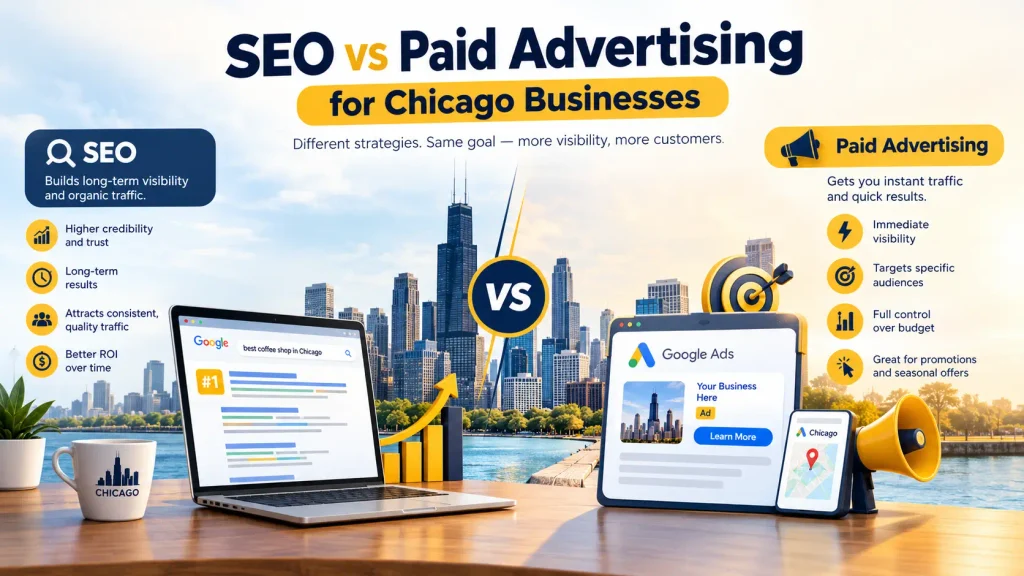
SEO vs Paid Advertising for Chicago Businesses
Neither is always better. They do different jobs.
| SEO | Paid advertising (PPC) | |
|---|---|---|
| Visibility | Builds over time | Can start soon after launch |
| Cost structure | Ongoing work and content | Pay per click or impression |
| After you stop | Past work may keep some value | Visibility stops with the budget |
| Testing | Slower to test | Fast to test messages and offers |
| Search intent | Matches many stages of search | Targets chosen terms and audiences |
| Landing pages | Needs strong pages | Needs strong pages |
| Tracking | Needs conversion tracking | Needs conversion tracking |
Some businesses use both. Paid ads can test which keywords and offers convert, and SEO can build lasting visibility around the ones that do. Others start with one and add the other later. The right mix depends on budget, competition, and how soon you need results.
FAQs
What is Chicago SEO marketing?
It is SEO work aimed at helping a business appear in search results for people in and around Chicago. It can include local SEO, technical fixes, content, links, and reporting.
How much does SEO cost in Chicago?
Prices vary widely. Providers use monthly retainers, hourly rates, and project fees. Cost usually depends on scope, competition, industry, number of locations, and the work needed. Ask each provider what is included before comparing quotes.
How long does SEO take to work?
It depends on your site, your competitors, and the work required. Some changes show effects sooner, while others take months. No provider can promise a timeline. Ask for a plan with checkpoints instead.
Is SEO worth it for a Chicago business?
It can be, when customers search for what you sell and your site can serve them. Compare the likely value of a customer with the cost of the work. An audit can help you judge fit.
What does a Chicago SEO company do?
It reviews your site and search presence, plans what to fix or build, carries out the work and reports on results. Services often include technical SEO, content, local SEO and link building.
What services are included in SEO marketing?
Common services include keyword research, on-page SEO, technical SEO, local SEO, content strategy, link building, competitor analysis, audits and reporting. Scope varies by provider.
Is local SEO different from regular SEO?
Yes. Local SEO adds location signals such as Google Business Profile, reviews, and citations, and focuses on searches tied to a place. It builds on the same website basics as regular SEO.
How can SEO generate leads?
It can bring qualified visitors to useful pages, where clear calls to action make contact easy. Conversion tracking shows which pages and searches lead to enquiries. SEO does not produce leads automatically.
How do I choose an SEO agency?
Check experience, reporting, scope, contract terms, and account ownership. Ask how they measure results. Be careful with guarantees about rankings or leads.
Can SEO help a business outside downtown Chicago?
Yes. Businesses in other parts of the city, in the suburbs, or across the wider metro area can use SEO. The plan should reflect where your customers are and which areas you actually serve.
What should an SEO report include?
It should show organic traffic, Search Console impressions and clicks, keyword visibility, leads and conversions, local visibility where measurable, technical health, and the work done. It should also explain what happens next.
Conclusion
Chicago SEO marketing works best when it starts with clear goals, matches what searchers want, and is measured by business results, not rankings alone. Use the steps and questions in this guide to review your own site or evaluate any provider you speak with.
If you want help applying this to your business, contact SoftAge Solutions to discuss your SEO goals.